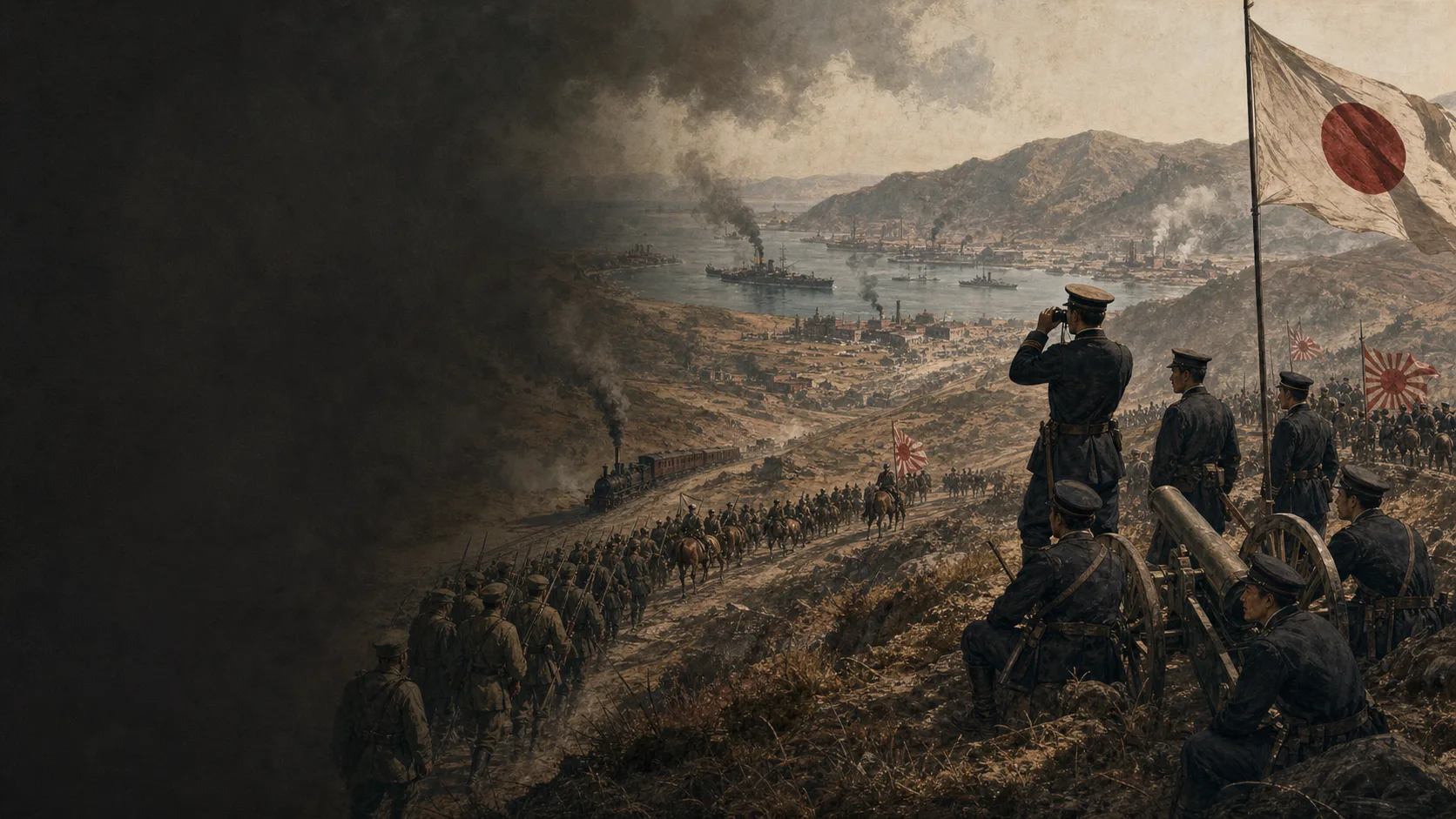
Port Arthur and the Japanese initiative
The initial naval attack, landings and siege of Port Arthur give Japan control of the tempo, but at the cost of very heavy losses.
War
Japan turns a peripheral war into a demonstration of industrial power
Military history
The Russo-Japanese War pits an island power carefully preparing a short war against a continental empire whose reinforcements must travel an immense distance. Japan does not win through absolute superiority everywhere: it concentrates its means around Port Arthur, Manchuria and the sea before Russia can deploy its full potential.
The initial naval attack, landings and siege of Port Arthur give Japan control of the tempo, but at the cost of very heavy losses.
Fighting in Manchuria shows that Russia can commit large forces, but distances and railway delays prevent a quick decision.
Russia’s Baltic Fleet arrives diminished by the voyage and meets a rested, well-informed and concentrated Japanese navy. Tsushima destroys the hope of reversing the war at sea.
Explore
Military history
Japanese movements, signals, order of battle and naval losses.
Doctrine, naval artillery, communications and industrial context.
Preparation of the Japanese navy, institutions and maritime strategy.
Section3 et légendes ⑤–⑥ relues ; carte⑤ des 9–10 mars réellement examinée, archives Chiyoda1062. Carte⑥ non examinée lors de cette révision.
Japanese institutional check of the final chronology, Nogi’s movement and relationship among city, railway and withdrawal; figures are retained as orders of magnitude from this source. Limited to the case of Battle of Mukden; this reference does not cover the whole conflict.
View ↗