1. Home
  2. Industrial Age
  3. Russo-Japanese War
  4. Battle of the Yellow Sea

Battle

Battle of the Yellow Sea

10 August 1904

Sortie · interception · command · dispersal

Military history

How does the Russian squadron lose its window to Vladivostok after passing its Japanese interceptor?

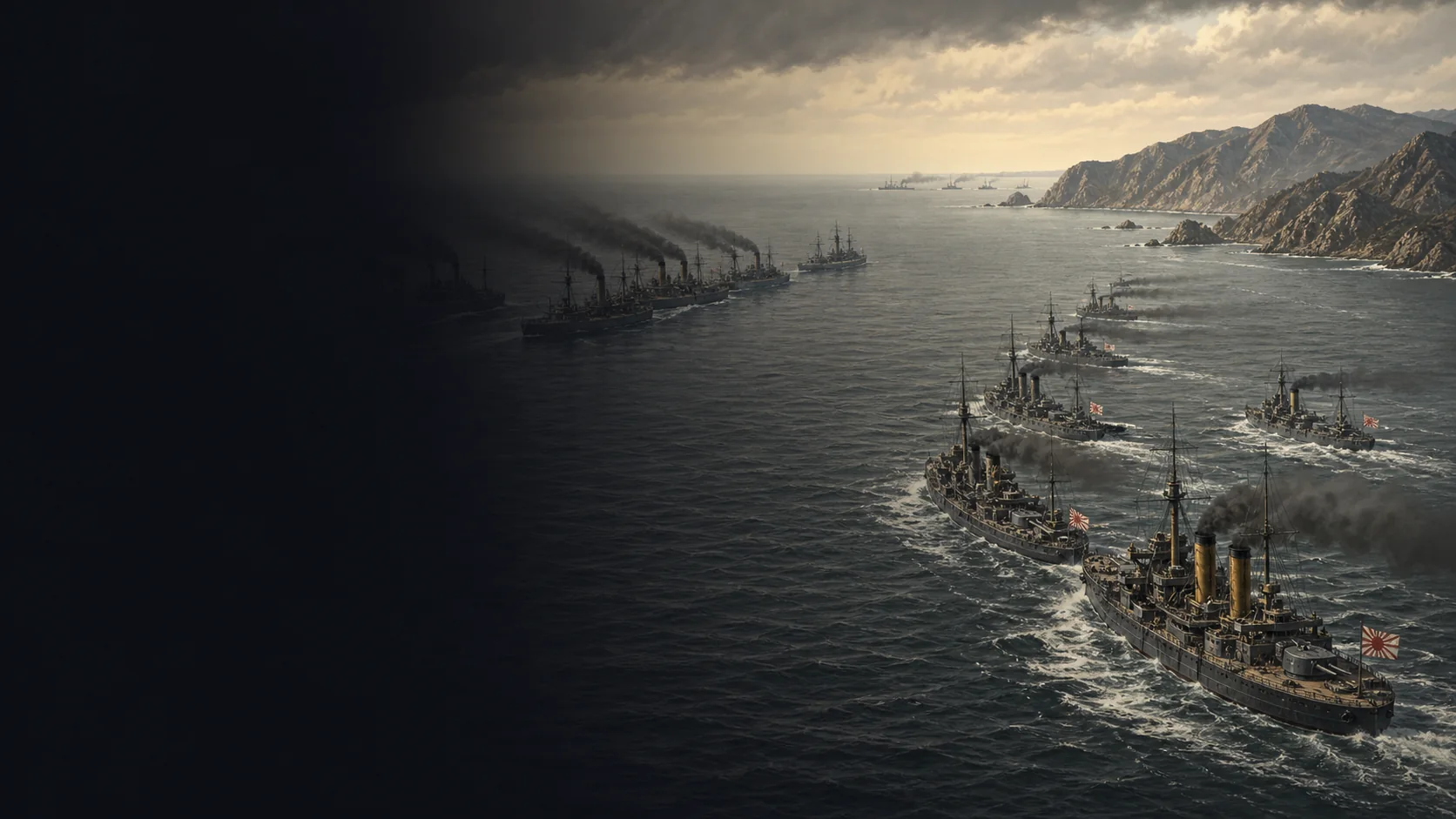
The battle arises from a Russian attempt to leave Port Arthur and reach Vladivostok before the siege makes the squadron unusable. Tōgō detects the sortie, regains contact after an inconclusive first action, then directs his fire at the Russian centre of command. The shift therefore comes not from the immediate annihilation of the battleships: Vitgeft’s death and the breakdown of signals turn a still-open route into a disunited retreat.

A besieged port, an ordered sortie

As Japanese forces tighten the siege of Port Arthur, keeping the squadron in the harbour becomes dangerous. On Viceroy Alekseyev’s order, transmitted in the tsar’s name, Vitgeft sails on 10 August with the objective of joining the Vladivostok cruisers; the mission is a breakout, distinct from the abstract pursuit of a duel.

An interception prepared by watchkeeping

Japanese picket ships report the sortie to Tōgō, who is near Round Island. The plan attributed to the Japanese admiral is to gain the head of the Russian column and concentrate fire on its flagships; the map shows this intention without converting it into an encirclement successfully achieved in advance.

Two actions, then a command problem

The first action ends when changes of heading separate the lines and momentarily leave the Russian route open. Japanese speed then allows contact to be regained; fire concentrates on Tsesarevich and Peresvet. The result must be described at two levels: tactically, the Japanese line does not sink the opposing fleet that day; operationally, the sortie is denied.

Military history

Sources

Archived contemporary sourceJapan Center for Asian Historical Records, “Review of the Russo-Japanese War by the Times (88) / The Battle on August 10”

Catalogue JACAR, référence A03023689800, rubrique « Summary » et métadonnées « Creation Date 1904.09.23 », 2 images : traduction japonaise d'une revue du Times britannique publiée le 15 août 1904.

Contemporary provenance, dating and check of the battle’s vocabulary; the notice is not used alone to reconstruct every heading.

View ↗
Institutional sourceCentral Naval Museum of Saint Petersburg, « Сражение в Желтом море в ходе Русско-японской войны 1904-1905 гг. »

Article du 10 août 2016 : paragraphes amorcés par « К июню 1904 года », « После приказа », « Японские дозорные корабли », « Контр-адмирал В.К. Витгефт » et « К 18 часам » ; siège, sortie, interception, mort de Vitgeft, retour et internement.

Operational framework, interception intent and mechanism of command loss.

View ↗
Specialised naval historyП. Д. Быков, « Русско-японская война 1904-1905 гг. Действия на море »

Section « Бой в Желтом море 10 августа 1904 г. », pp. imprimées 532–544 : du paragraphe « 10 августа в 8 час. 45 мин. » à ceux décrivant la mort de Vitgeft, l'avance du Retvizan, le signal d'Ukhtomsky, les attaques nocturnes et les ports d'internement.

Tactical chronology, sequence of the two actions, command damage and dispersal; Bykov’s judgements are identified as a specialist interpretation.

View ↗
Specialised naval history, Naval Institute Press editionJulian S. Corbett, Maritime Operations in the Russo-Japanese War, 1904-1905, Volume One

Volume I : chapitre XXI « Situation at Port Arthur—July 24th—August 10th », p. 353 ; chapitre XXII « The Battle of the Yellow Sea », « Movements before contact », p. 370, « The first action », p. 380, « The second action », p. 389, « The flotilla attack », p. 405 ; chapitre XXIII « Movements after the action », p. 414.

Specialised naval division, relative positions and check of the cartographic reconstruction; the accessible table of contents does not replace a detailed citation.

View ↗
University encyclopaediaSiobhan Peeling, “Russo-Japanese War”, International Encyclopedia of the First World War

Section 2.1 « The War at Sea », PDF p. 2/5, paragraphe amorcé par « Japanese naval manoeuvres at Port Arthur » : sortie vers Vladivostok, mort de Vitgeft, retour et internement ; référence de citation et DOI p. 4/5.

Independent synthesis of the operational result and distinction between the Battle of the Yellow Sea and later losses.

View ↗
Institutional military monographWilliam Hammac, The Russo-Japanese War of 1904-1905 and the Evolution of Operational Art, US Army Command and General Staff College

PDF p. 12, tableau chronologique des engagements, ligne du 10 août 1904 : « Yellow Sea — Naval battle — Tactically inconclusive ».

Check of the level of result: distinction between the Japanese operational outcome and the tactical inconclusiveness of the fleet action.

View ↗
Institutional source and photographic testimonyUS Naval History and Heritage Command, “NH 101324 Battle of the Yellow Sea, 10 August 1904”

Catalogue NH 101324, légende « Entrance Port Arthur, August 10, 1904 » ; description tirée du rapport de Lieutenant Commander N. A. McCully, Russo-Japanese War, vol. 1, p. 152a.

Documentary reference for the sortie from Port Arthur and cartographic reconstruction of the setting. Use for precise tactical geometry would exceed the documentary scope adopted here.

View ↗

Edited by BattlesInMotion.com