A destination made urgent
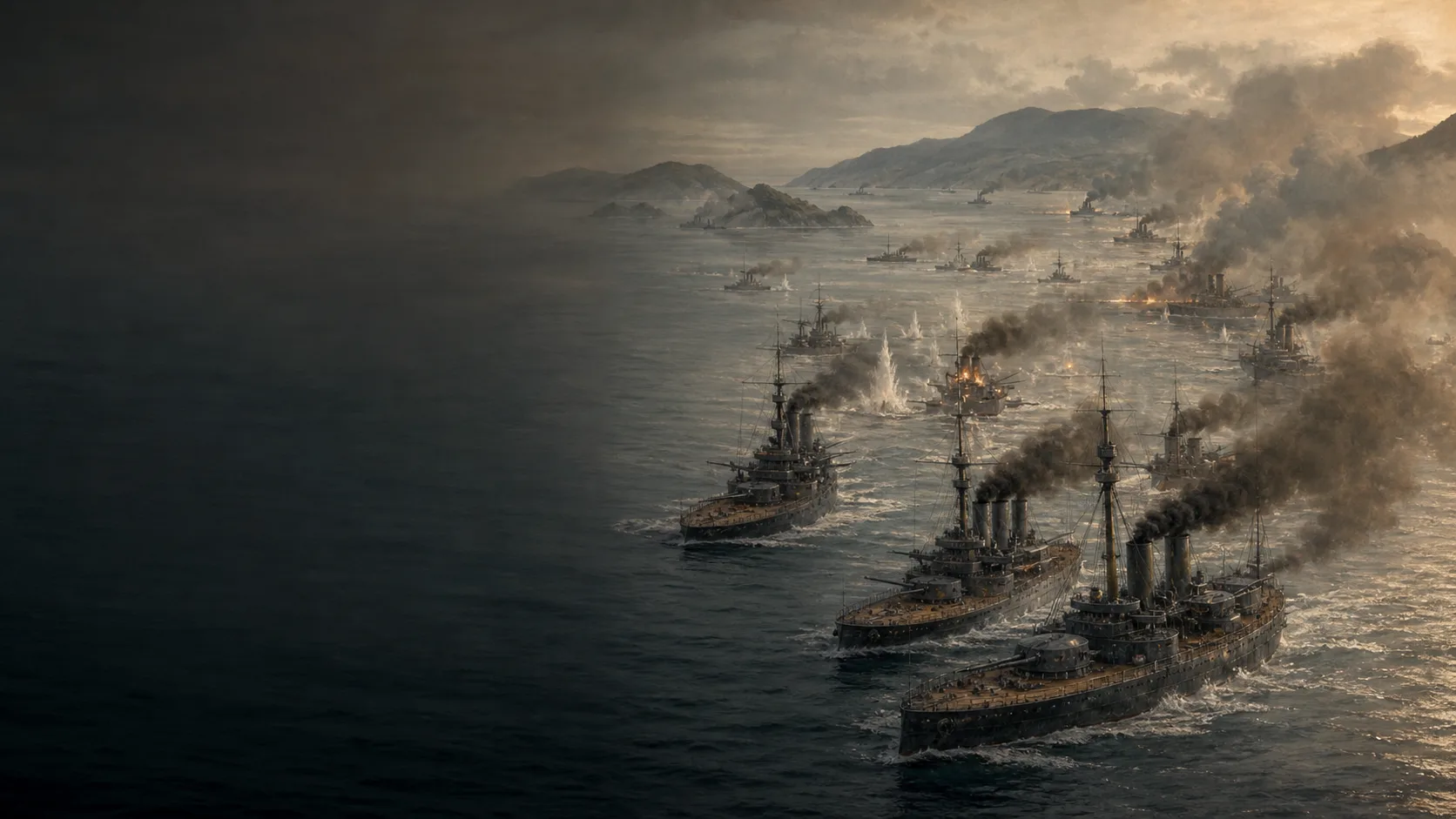
Port Arthur has fallen. The fleet from the Baltic must now reach Vladivostok. Its mix of speeds and ships complicates a common route, but it includes four new Borodino-class battleships.
Battle
Japanese manoeuvres break Russian command before the night pursuit.
Military history
The Russian fleet seeks to reach Vladivostok after a long voyage from the Baltic. Spotted in the strait, it meets a Japanese fleet repaired and trained near its bases. Tōgō turns across its path, then his ships fight on a nearby course. The Russians change course and leading ship several times. Damage to Suvorov deprives the squadron of command as losses mount. After evening sinkings and night attacks, four ships surrender with Nebogatov; others flee, are destroyed or reach neutral ports.
Port Arthur has fallen. The fleet from the Baltic must now reach Vladivostok. Its mix of speeds and ships complicates a common route, but it includes four new Borodino-class battleships.
Shinano Maru reports the Russian fleet at dawn. Other ships maintain contact; Tōgō leaves Chinhae and heads towards its route with his battleships and Kamimura’s armoured cruisers.
As the battle approaches, the four Borodino ships join the head of a single line. Oslyabya slows sharply to let them pass. The transition exposes both leading ships as the firing begins.
Explore
Military history
Texte détaillé intégral ; reproduction anglaise non critique.
Interception, turns, division separation, attacks and surrenders; provisional tally explicitly attributed.
View ↗Passages pp.48–60,63–93,104–165 lus ; ordre de bataille pp.163–165. Diagramme absent de cette édition.
Experience aboard Suvorov, rudder damage, succession among leading ships and the admiral’s transfer; a partial and situated account.
View ↗Récit et sorts des bâtiments lus jusqu’aux leçons ; informateur transmis anonymement.
Columns reunited, Oslyabya slowed, cruisers interned and Almaz; Russian yellow funnels. Estimates of hits are not reused.
View ↗Introduction, première rencontre et attaques de torpilleurs relues.
Kamimura behind Tōgō at first, later separation and uncertainty about the routes.
View ↗Présentation de la bataille entièrement relue.
Fleet repairs, training and departure from Chinhae after the Shinano Maru’s signal.
View ↗Liens Battle of Tsushima, plans1–4 ; quatre images intégralement examinées, origine éditoriale non précisée.
Initial deployment, afternoon loops and pursuit north; cross-checked against accounts, not certified positions.
View ↗Caractéristiques et description du navire relues dans le dossier Mer Jaune.
Reuse of a depiction of a Mikasa-type battleship: two funnels and main guns in two twin turrets.
View ↗