1. Home
  2. World Wars
  3. First World War
  4. Caporetto

Battle

Caporetto

24 October — 12 November 1917

Plezzo, the valley floor, and the Tolmino ridges give way almost together; the Second Army loses cohesion.

Military history

How did three coordinated penetrations turn a sectoral break into a retreat all the way to the Piave?

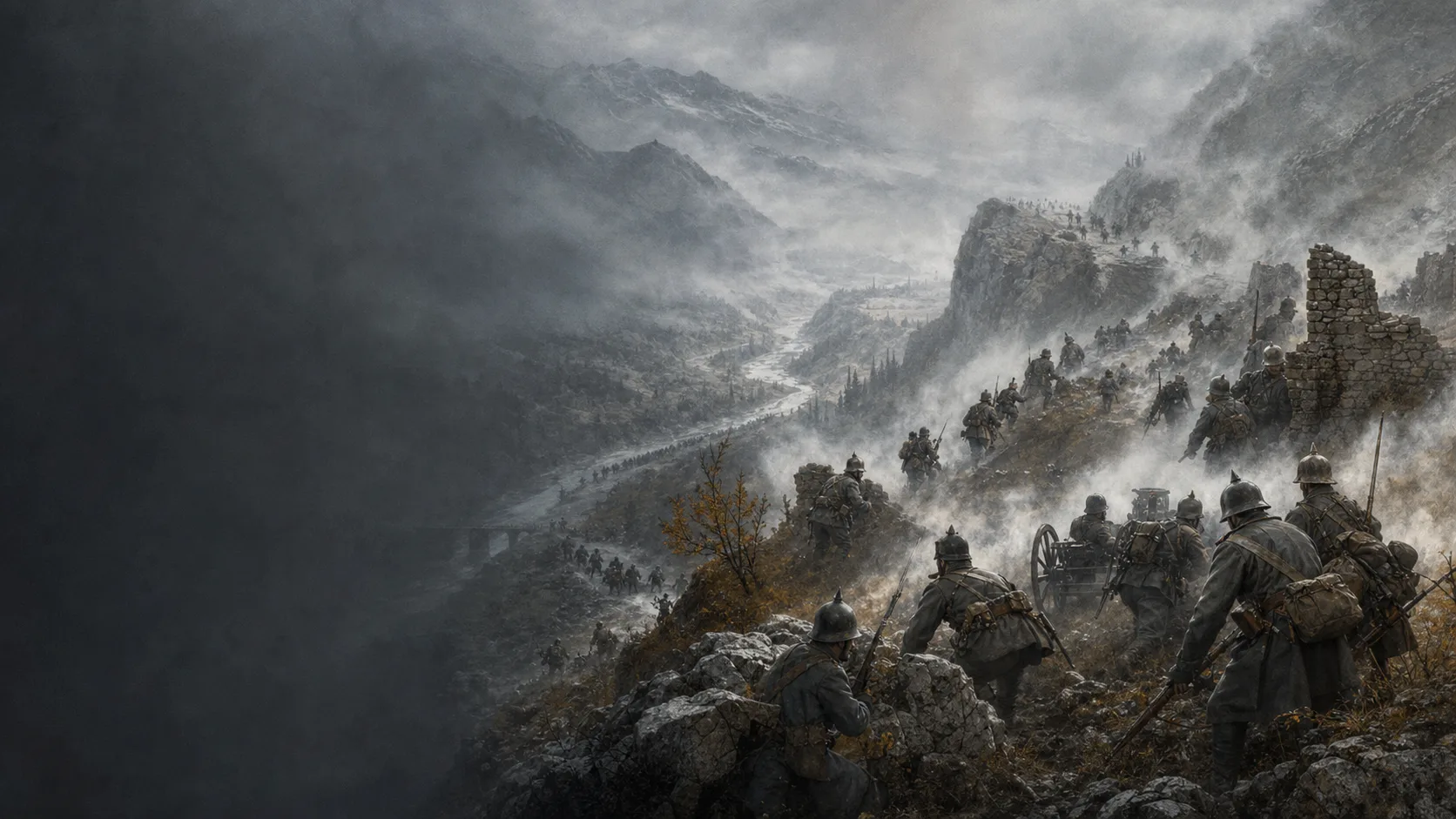
Caporetto cannot be reduced either to a successful bombardment or to a failure of morale. On 24 October, the Krauss Group breaks out of the Plezzo basin toward Saga; from Tolmino, the 12th Silesian Division advances up both banks of the Isonzo to Caporetto while the Alpenkorps gains the spurs of the Kolovrat. The collapse of IV and XXVII Corps makes the line impossible to command as a continuous front; retreat toward Cividale, Udine, the Tagliamento, and then the Piave becomes the army’s condition for survival.

An Austro-Hungarian army in need of relief

After the Italian offensive on the Bainsizza Plateau, the Austro-Hungarian command obtains German assistance and forms a Fourteenth Army of fifteen divisions. The consulted syntheses differ on their national distribution—nine Austro-Hungarian and six German in Grillini, eight and seven in Treccani—but agree on the total and on Otto von Below’s command.

Basin, valley, and ridges

The plan assigns distinct functions. In the north, the Krauss Group must force Plezzo, Saga, and the Stol. From Tolmino, the 12th Silesian Division must advance toward Caporetto along both banks of the Isonzo; the Alpenkorps targets Costa Raunza, Costa Duole, and then the Kolovrat ridge. These penetrations are meant to open the approaches to Cividale before the Italian reserves can react.

The break runs through corps and roads

The short, intense bombardment also targets communications. By the time reports of the break between Plezzo and Tolmino reach supreme command, IV and XXVII Corps have already been outflanked; the heights and exit routes matter more than retaining every trench.

Explore

Chronological dossier

Battle · 21 February — 15 December 1916VerdunThe German concentration opens the right bank but does not take Verdun; reliefs, artillery and the Sacred Way stabilise both banks, then the October and December offensives recapture Douaumont, Vaux and most of the eastern gains.Battle · 8 — 12 August 1918AmiensThe Allies combine tanks, artillery, aviation and infantry to break German defences before they can be rebuilt.Battle · 19 — 25 September 1918MegiddoAllenby pins the Ottomans in the east, breaks through near the coast and sends cavalry into the rear of the Eighth Army.Battle · 26 — 30 August 1914TannenbergThe Germans strip the north, strike Samsonov's two wings separately, then close the roads through Neidenburg, Passenheim and Willenberg around his centre.Battle · 19 February 1915 — 9 January 1916Gallipoli CampaignMines halt the naval gamble; separate landings remain contained below the ridges, then deception enables the evacuation of Anzac, Suvla and Helles.Battle · 1 July — 18 November 1916Battle of the SommeThe bombardment produces opposite results in different sectors; gains in the south and at Bazentin run into strongpoints and reserves, then four months of adaptation push the front back without opening it.Battle · 4 June — 20 September 1916Brusilov OffensiveFour armies prepare several sectors and open the Austro-Hungarian front together; when reserves belatedly concentrate towards Kovel, the Stokhid, German reinforcements and lengthening supply lines exhaust the exploitation.Battle · 31 May — 1 June 1916Battle of JutlandHipper draws Beatty towards Scheer, then Beatty leads the pursuit back onto Jellicoe; two unfavourable deployments force Scheer to disengage through battle turns, smoke and torpedoes, before a night escape saves his fleet without loosening the blockade.

Military history

Sources

Official inquiry report, retrospective primary sourceRelazione della Commissione d’inchiesta, Dall’Isonzo al Piave, volume II

Édition de 1919, pp. 101–179, « Osservazioni su talune operazioni » : repli de Saga, action de la 19e division, avance sur Caporetto par le fond de l’Isonzo, emploi du VIIe corps et occupation du Matajur ; pp. 228–249, communications, ponts et services logistiques.

Checking the Italian sequence of the break, command difficulties, and retreat, while noting the inquiry’s retrospective and contested nature.

View ↗
Academic and institutional synthesisAnna Grillini, Caporetto, Battle of, International Encyclopedia of the First World War

PDF, pp. 1–3 : formation de la 14e armée ; plan Plezzo–Tolmino ; déclenchement à 2 h le 24 octobre ; infiltration et brouillard ; Cividale, Udine, Tagliamento, Piave et pertes en fin d’offensive.

Chronology, causal mechanism, army-level formations, consequences, and casualty orders of magnitude.

View ↗
Archival cartographic sourceFondo Capello, Carta topografica dello schieramento dell’artiglieria al 24 ottobre 1917

Istituto per la storia del Risorgimento italiano, Fondo Capello, busta 896, fascicolo 1 : carte du 24.10.1917 entre Gorizia et Caporetto, avec les IVe, XXVIIe, IIe, VIe et VIIIe corps ; annexe au document N.13 p.24 de l’appendice de Capello.

Archival grounding for the Italian deployment and checking the map of the initial sector.

View ↗
Contemporary cartographic sourceItalian (Isonzo) front, 1st Anzac Corps Topographical Section, 1917

Australian War Memorial, LIB52247, call number G6710 s250 : carte au 1:250 000, relief par courbes et points cotés, ligne italienne au 1.1.1917, ligne approximative de l’offensive austro-allemande et directions principales des poussées.

Relief, front lines, axes of advance, and cartographic checks on the Isonzo–Friuli corridor.

View ↗
Contemporary institutional sourceAustralian War Memorial, Rendering a small service to Italy in 1917

Article de Dianne Rutherford, 27 octobre 2014, paragraphes sur la percée du 24 octobre, le recul d’environ 100 km jusqu’au 10 novembre, et la carte AIF datée du 27 octobre montrant la ligne initiale et les poussées austro-allemandes.

Institutional confirmation of the direction of retreat and the status of the contemporary AWM map.

View ↗
Modern institutional encyclopedia of the eventTreccani, voce Caporetto

Enciclopedia Italiana (1930), section ‘La battaglia di Caporetto’ : convergence des colonnes descendant de la conque de Plezzo et remontant du camp retranché de Tolmino ; rupture des IVe et XXVIIe corps ; ordre de bataille italien ; progression de la 12e division germanique et de l’Alpenkorps le 24 octobre.

Geographical and nominal checks on the two axes, the Italian front-line corps, and the Kolovrat–Matajur objectives.

View ↗
Academic overviewVanda Wilcox, Italian Front, International Encyclopedia of the First World War

Section ‘Catastrophe: The Italian Defeat at Caporetto’, paragraphes sur la stabilisation après le Tagliamento, le retrait vers le Piave le 4 novembre, la chute de Boselli, le remplacement de Cadorna par Diaz et les conditions alliées au soutien.

A cautious formulation of the political chronology and the transition from Cadorna to Diaz, without inventing a prior formal decision.

View ↗

Edited by BattlesInMotion.com