1. Home
  2. World Wars
  3. First World War
  4. Gallipoli Campaign

Battle

Gallipoli Campaign

19 February 1915 — 9 January 1916

From the mines in the Straits to the silent evacuations

Military history

How did an amphibious operation successful in reaching shore remain pinned beneath the ridges until evacuation?

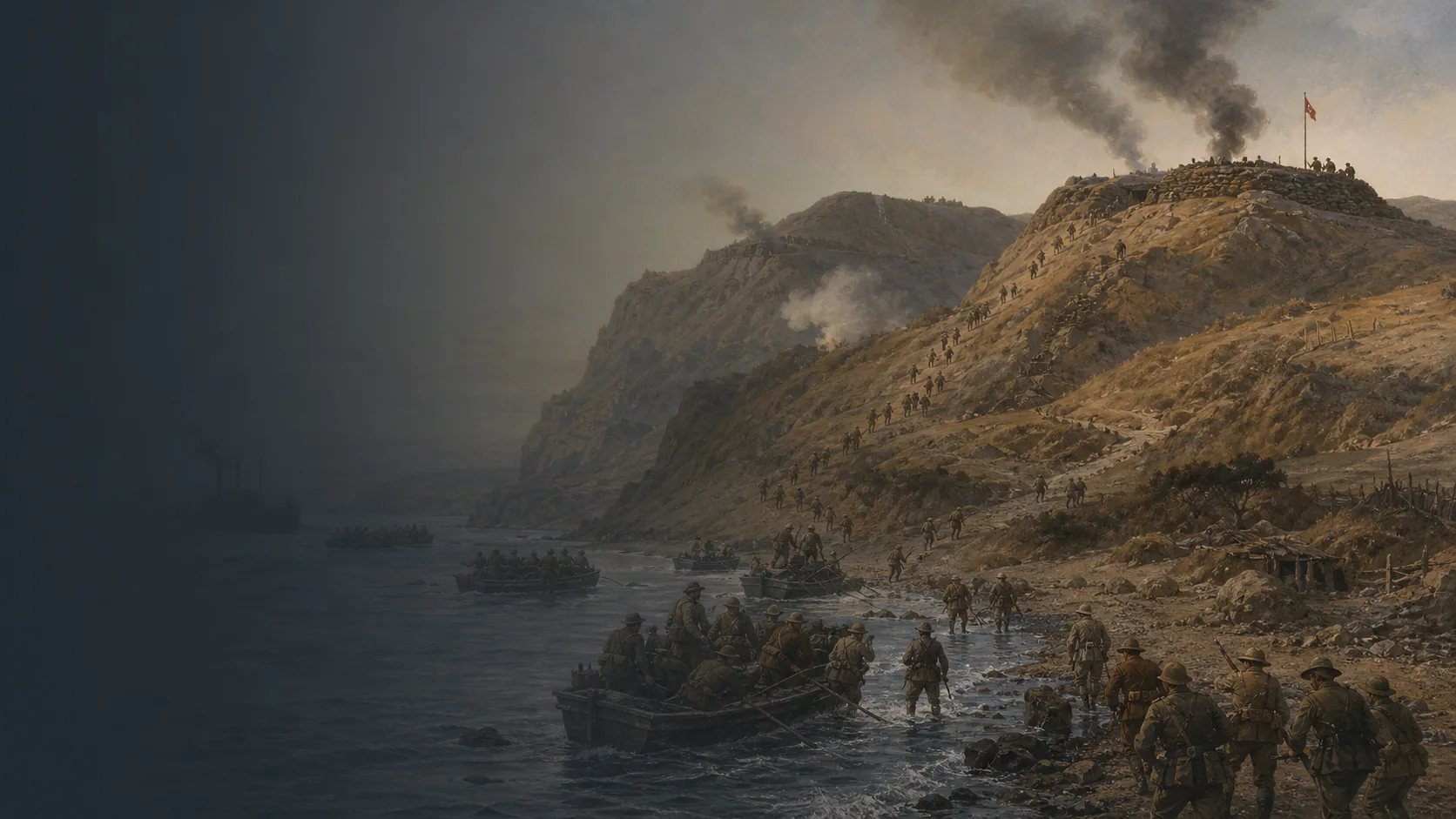
Gallipoli was a campaign, not an instantaneous battle. From 19 February to 18 March 1915, the Entente first tried to force the Dardanelles by sea. After that failure, it prepared and on 25 April opened separate beachheads at Helles and Arıburnu-Anzac; in August, it added a third at Suvla without capturing the ridges. When winter came, it withdrew from Anzac and Suvla in December, then from Helles in January. Between these sequences, neither side had a complete picture: the Allies underestimated the terrain and concentration times; the Ottomans had to infer the points of effort and move their reserves in time.

A gamble that began at sea

The Entente sought to open a sea route to Russia and threaten Constantinople. From 19 February to 17 March, its bombardments and minesweeping made little progress. On 18 March, mines—including the line laid by Nusret in Erenköy Bay—and fire from the forts stopped the attempted passage. This defensive success still did not reveal to the Ottomans where a land operation might follow.

Five weeks to change method

On 22 March, the naval and military authorities selected a combined operation. The absence of the 29th Division and the concentration of troops at Alexandria delayed the assault until late April. The delay allowed transports and contingents to assemble, but also enabled the Ottoman Fifth Army, created on 26 March, to organise a defence in depth with coastal detachments and reserves inland.

Maps too poor for the ravines

At Arıburnu, the Allied survey derived from an 1854 French map, supplemented belatedly by aerial reconnaissance. It represented slopes and ridges imperfectly. Once ashore, units dispersed across spurs and ravines; the Australian 3rd Brigade report shows mixed groups, difficult communications and movement in single file along narrow paths.

Three fronts, three distinct drives

Helles was to take Krithia and Achi Baba; ANZAC was to gain Sari Bair and then cut the peninsula; Suvla, opened only in August, was to provide space and join Anzac. The objectives were linked, but beaches and commands remained separate. The Ottoman defence could therefore contain each beachhead by holding the heights and committing reserves where the threat became legible.

Explore

Chronological dossier

Battle · 21 February — 15 December 1916VerdunThe German concentration opens the right bank but does not take Verdun; reliefs, artillery and the Sacred Way stabilise both banks, then the October and December offensives recapture Douaumont, Vaux and most of the eastern gains.Battle · 24 October — 12 November 1917CaporettoThree coordinated penetrations through Plezzo, the Isonzo valley and the ridges shatter the IV and XXVII Corps, then the pursuit drives the Italian army back to the Piave.Battle · 8 — 12 August 1918AmiensThe Allies combine tanks, artillery, aviation and infantry to break German defences before they can be rebuilt.Battle · 19 — 25 September 1918MegiddoAllenby pins the Ottomans in the east, breaks through near the coast and sends cavalry into the rear of the Eighth Army.Battle · 26 — 30 August 1914TannenbergThe Germans strip the north, strike Samsonov's two wings separately, then close the roads through Neidenburg, Passenheim and Willenberg around his centre.Battle · 1 July — 18 November 1916Battle of the SommeThe bombardment produces opposite results in different sectors; gains in the south and at Bazentin run into strongpoints and reserves, then four months of adaptation push the front back without opening it.Battle · 4 June — 20 September 1916Brusilov OffensiveFour armies prepare several sectors and open the Austro-Hungarian front together; when reserves belatedly concentrate towards Kovel, the Stokhid, German reinforcements and lengthening supply lines exhaust the exploitation.Battle · 31 May — 1 June 1916Battle of JutlandHipper draws Beatty towards Scheer, then Beatty leads the pursuit back onto Jellicoe; two unfavourable deployments force Scheer to disengage through battle turns, smoke and torpedoes, before a night escape saves his fleet without loosening the blockade.

Military history

Sources

Contemporary primary source, brigade reportReport on operations at Anzac 25 April–3 May 1915 — AWM255/166

Transcription directe du rapport du commandant de la 3rd Australian Infantry Brigade : p. 1, débarquement au nord de Gaba Tepe sous le feu et répartition des bataillons ; pp. 2–4, contre-attaques du 25 avril et tenue de Spur 400 ; pp. 7–8, positions du 30 avril au 1er mai et tableau des pertes.

Grounding the Anzac landing in a contemporary report: dispersed units, small-group communications, counterattacks, holding the lower ridges and one brigade's casualties—without generalising that sector to the whole peninsula.

View ↗
Institutional campaign synthesisGallipoli 1915 — Australian War Memorial

Paragraphes « Gallipoli 1915 » : débarquement australien du 25 avril et tête de pont précaire ; tentatives d’août ; évacuation des 19–20 décembre ; 26 111 pertes australiennes dont 8 141 morts ; note finale distinguant Anzac-Suvla de Helles le 9 janvier.

Cross-checking the chronology, establishing the Australian casualty subtotal and separating the northern evacuations from that of Helles.

View ↗
Institutional source and historical cartographyMaps at the landing at Anzac Cove — Australian War Memorial

Sections « The maps used at the landing » et « The terrain » : carte alliée au 1:40 000 dérivée d’un relevé français de 1854, compléments par reconnaissance aérienne, erreurs de hauteur et de direction, relief réel d’éperons et de ravins.

Establishing cartographic limits, the Arıburnu and Sari Bair references, and the causal role of terrain without attributing knowledge to staffs that they did not possess.

View ↗
Official Australian synthesis and annotated mapLanding at Anzac Cove 25 April 1915 — Anzac Portal

Introduction et sections « Map of the landings » puis récit de la journée : environ 16 000 Australiens et Néo-Zélandais débarqués, plus de 2 000 tués ou blessés avant le lendemain, arrivée autour d’Arıburnu, ravins et éperons, objectifs non atteints, recommandation de retrait le soir.

Defining the scope of Anzac, its depth on the first evening and uncertainty over the landing place without reducing the whole campaign to a ‘wrong beach’.

View ↗
Official Australian synthesis with evacuation chronologyEvacuation from Gallipoli 1915 — Anzac Portal

Résumé et sections « Plan for a quiet withdrawal », « First and second stages » et « Final stage » : 90 000 hommes embarqués secrètement de Suvla et Anzac du 8 au 20 décembre ; garnison d’Anzac prévue de 41 000 à 26 000 puis 20 277 hommes le 18 ; dernières nuits des 18–19 et 19–20 décembre ; Helles les 8–9 janvier.

Reconstructing the stages, volumes and deceptive methods of withdrawal while separating the north from the later evacuation of Helles.

View ↗
Official Turkish synthesis, institutional narrativeÇanakkale Cephesi — ministère turc de la Défense

Sur la longue page « Millî Mücadele Dönemi », section « Çanakkale Cephesi » : amorces exactes « İtilaf devletlerinin deniz harekâtı » (19 février–17 mars), « Çanakkale Müstahkem Mevki Komutanı » (vingt-six mines posées par le Nusret le 8 mars), « 26 Mart 1915'te kurulan 5'inci Ordu » (défense en profondeur) et « Çanakkale Cephesi'ndeki kara muharebeleri » (57e régiment et évacuations d’Arıburnu-Anafarta puis de Seddülbahir).

Documenting Ottoman dispositions and dates from a direct national source, used cautiously for its commemorative tone and cross-checked for mechanisms.

View ↗
Turkish academic article based on Turkish and British archivesİtilaf Kuvvetleri’nin Gelibolu Yarımadası’na Çıkarma Harekâtı (25 Nisan 1915) — Figen Atabey

Résumé anglais et turc, paragraphes 1–4 : décision d’opération combinée du 22 mars, retard lié à la 29e division et au regroupement d’Alexandrie, cinq plages d’Helles et Arıburnu, environ 29 000 hommes débarqués avant la nuit, dont 3 000 Français à Kum Kale ; références aux fonds ATASE, ADM et WO.

Fixing the transition from naval to land operations, the preparation timetable and the scope of first-day strength; its teleological conclusion is not adopted.

View ↗
Turkish academic article and historiographical studyTürk Kaynaklarının Gelibolu Yarımadası’nın Tahliyesiyle İlgili Değerlendirmeleri — Yüksel Nizamoğlu

Résumé anglais et turc, paragraphes 1–3 : passage aux tranchées et réduction des forces à partir de septembre, évacuations de décembre à début janvier, critique dans les sources turques du commandement de la 5e armée et de Liman von Sanders ; bibliographie d’histoires officielles et rapports contemporains.

Restoring the Ottoman debate over failure to detect or exploit the evacuation, without converting retrospective criticism into a certain outcome for a hypothetical attack.

View ↗
Military museum synthesisGallipoli campaign — National Army Museum

Sections « Forcing the straits », « The force », « Landings », « Cape Helles », « Anzac », « Battles for Krithia », « August offensive », « Trapped », « Withdrawal » et « Aftermath » : mines et forts, absence d’engins spécialisés, cinq plages d’Helles, trois attaques sur Krithia, effort triple du 6 août, trois têtes de pont, plus de 220 000 pertes alliées sur près de 500 000 hommes.

Checking geography, the Allied order of battle, each sector's intentions, the August sequence, evacuation and orders of magnitude across the campaign.

View ↗
International academic synthesisGallipoli, Campaign and Battle of — 1914–1918 Online

Sections « Ottoman Defensive Preparations », « Initial Actions », « Major Operations » et « The End of the Campaign » : en mars 230 pièces mobiles ou obusiers et 82 fixes, IIIe corps à trois divisions, échec naval, 5e armée, débarquements, Krithia et août ; puis 205 000 pertes du Commonwealth, 47 000 françaises, 251 000–289 000 ottomanes, avec morts et disparus distingués.

Balancing Allied documentation with an academic synthesis centred on Ottoman dispositions, and attaching a date or scope to strength, artillery and casualties.

View ↗
New Zealand institutional chronologyGallipoli timeline — NZ History

Entrées datées : 18 mars attaque navale ; 25 avril débarquements ; 28 avril, 6–8 mai et 4 juin attaques sur Krithia ; 19 mai attaque ottomane à Anzac ; 6–10 août Suvla et Chunuk Bair ; 21 puis 27–29 août Hill 60 ; 20 décembre évacuation du nord ; 9 janvier fin d’Helles.

Checking the bounds of all eight phases and preventing Suvla, the Chunuk Bair fighting or an evacuation from appearing before its date.

View ↗

Edited by BattlesInMotion.com