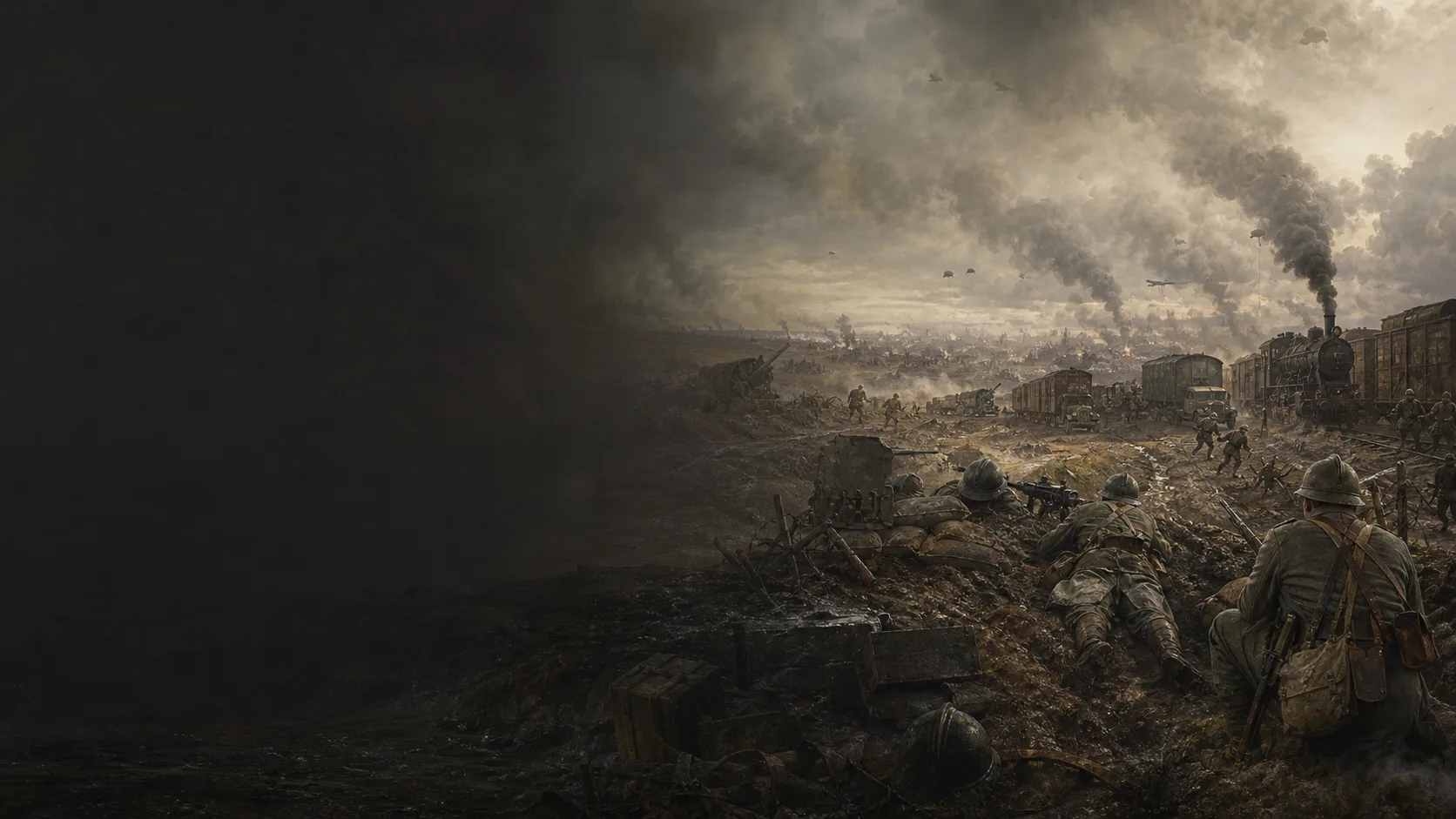
Movement, then deadlock
Mobilisation and invasion plans move armies rapidly, but the Marne and the Race to the Sea turn the Western Front into a fortified system.
War
Firepower, depth and attrition seek a way through the continuous front
Military history
The First World War begins as a war of movement and becomes an industrial conflict in which armies must produce, replace and supply on an unprecedented scale. Offensives are not merely attacks on trenches: they test the ability to coordinate artillery, infantry, aircraft, reserves and transport over several weeks.
Mobilisation and invasion plans move armies rapidly, but the Marne and the Race to the Sea turn the Western Front into a fortified system.
Verdun, the Somme, the Eastern Front and Italy show that defensive fire can absorb immense attacks. General staffs search for methods to restore mobility.
American arrival, tanks, coordinated artillery and the Central Powers’ crisis allow the Allies to combine several offensives and turn a local breakthrough into a general retreat.
Explore
Military history
Operations, orders, movements and losses in the British campaigns.
Relationship between fronts, economics, coalitions and political decisions.
Production, naval power, mobilisation and the transformation of industrial warfare.
Ch. V, pp. 81–90, échelons et artillerie mobile ; ch. VI, pp. 99–108, secret, calibration et chars ; ch. VII, pp. 120–128, messages et Chipilly ; ch. VIII, pp. 133–143, reprise vers Lihons et limites.
Australian plan and execution, material mechanisms, reliefs, flank fire and 1916 terrain; a situated account, not presumed neutral. Limited to the case of Amiens; this reference does not cover the whole conflict.
View ↗