After Ulm
Napoleon has destroyed the Austrian army in Germany, but Russian forces are arriving and the Grande Armée is stretched around Vienna.
Battle
Hold the Goldbach villages, take Pratzen, then turn against the southern columns.
Military history
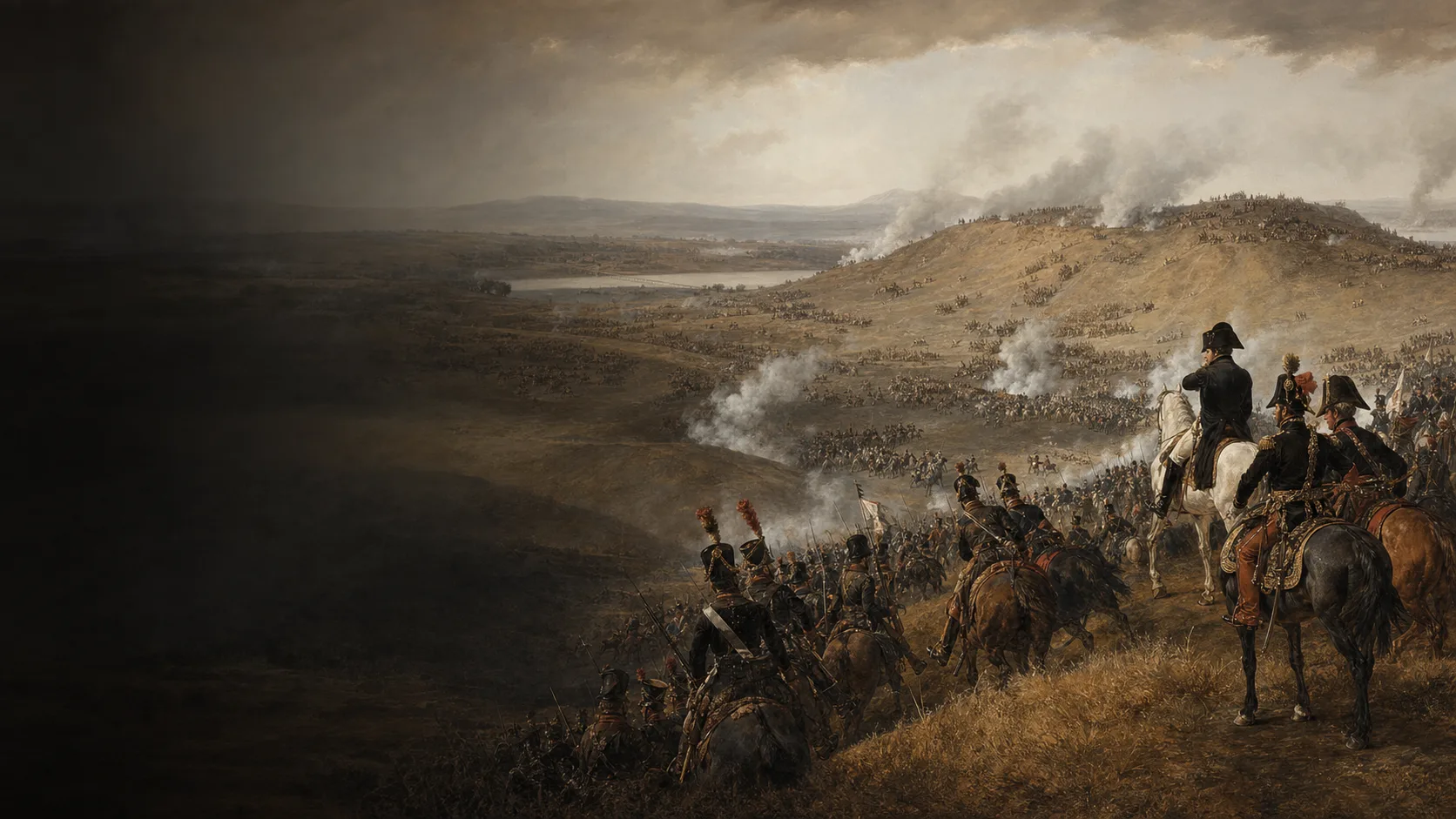
The allied plan aims to turn the French right by descending towards Telnitz and Sokolnitz. Napoleon accepts that risk and concentrates his attack on Pratzen. But taking the heights does not end the battle: Soult must repel counterattacks, the two Guards clash and the southern columns continue fighting. The decision comes when the French can leave the plateau southwards while holding their other sectors.
Napoleon has destroyed the Austrian army in Germany, but Russian forces are arriving and the Grande Armée is stretched around Vienna.
Weyrother’s plan requires several columns to cross the same valleys while cavalry moves to its assigned sector. Crossing routes, fog and distances make coordination difficult.
The Allies descend from Pratzen to reach the French right. Napoleon attacks the heights during this movement, but part of the allied centre and recalled troops can still defend them.
Explore
Military history
Section Battle of Austerlitz, du plan allié à la retraite de Dokhtourov ; texte distingué des notes françaises
Sequence of fighting, allied responses, the Guards and the retreats; Austrian account compared with modern research without treating its judgments as fact.
View ↗Sections consacrées au terrain et à la manœuvre du 2 décembre
Corps deployment, descent of the Allied columns, and Soult’s attack across Pratzen.
View ↗Carte et commentaire historique publiés par les bibliothèques Bodléiennes
Reading of the terrain, Goldbach and Pratzen, and a warning against a simplified representation of the manoeuvre.
View ↗30e Bulletin, publié au lendemain d’Austerlitz
The immediate French account of the tactical sequence, checked against modern studies for its exaggerations, especially concerning the frozen ponds.
View ↗Notice des figurines, paragraphes uniformes et armement
White uniform, helmet and equipment of Austrian infantrymen.
View ↗Rubriques Čáka, Kabátec, Kalhoty, Boty et Výzbroj
Generic depiction of a Russian infantryman in 1805; uniform differences are not assigned to a specific regiment.
View ↗Campagne de 1805 et 26 décembre
Campaign context and the Peace of Pressburg; tactical times are not used as a minute-by-minute chronology.
View ↗Introduction et rapports de janvier 1806, notes 2 à 5
Orders of magnitude for casualties and the distinction between men initially reported absent and final losses.
View ↗