Defeat the armies separately
Napoleon crosses the Sambre on 15 June to prevent Wellington and Blücher from combining their forces. Ligny defeats the Prussians on 16 June but does not destroy them; Quatre Bras allows Wellington to remain in contact.
Battle
A ridge holds long enough for two allied armies to unite.
Military history
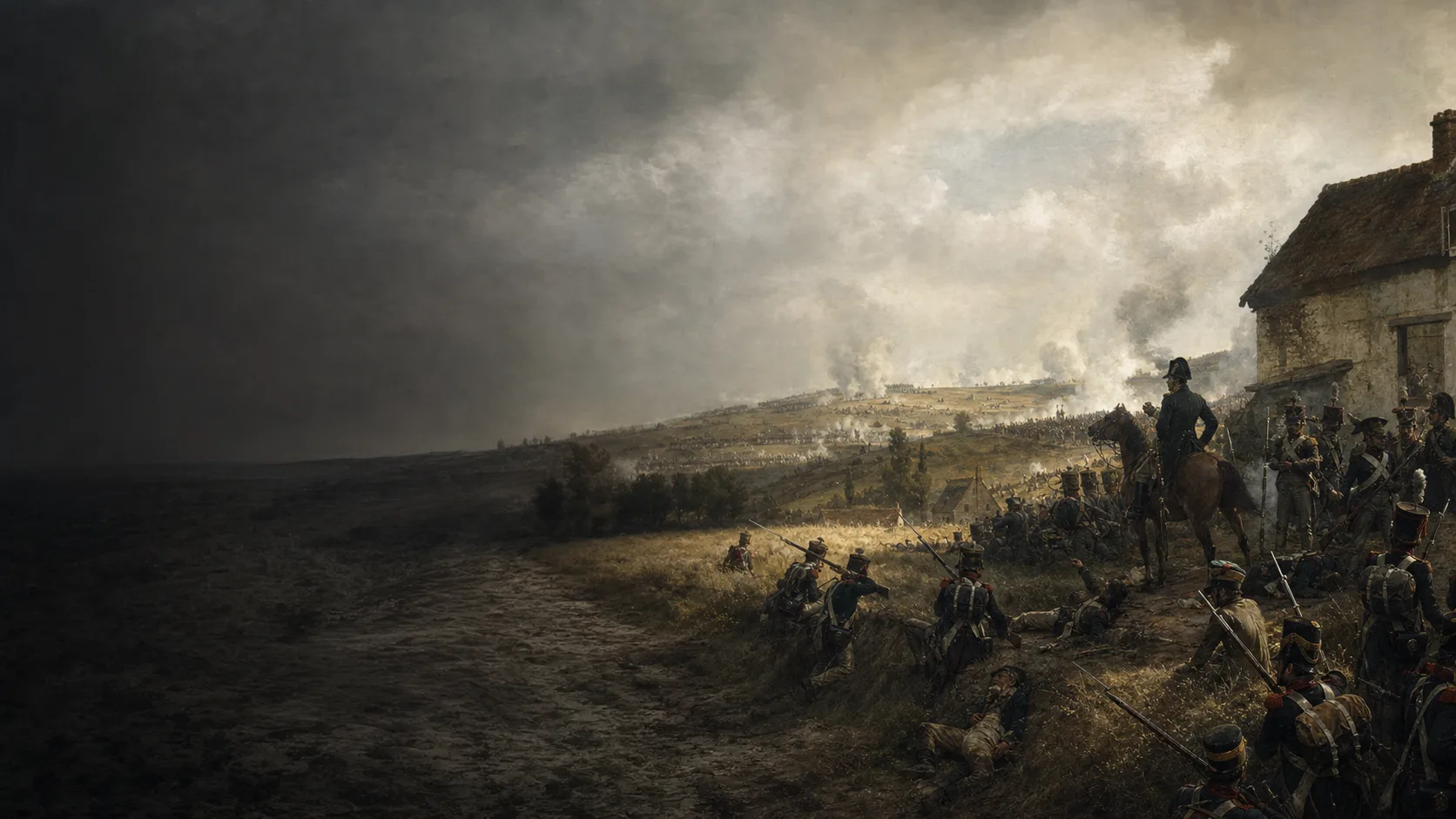
Wellington held a ridge south of Waterloo while waiting for Blücher. The French attacked the farms, the line and the squares but achieved no lasting breakthrough. The capture of La Haye Sainte nevertheless weakened the Allied center. The Prussians then engaged the French flank at Plancenoit and joined Wellington’s left near Papelotte. The French reserve was split between two fronts. When the Guard’s final attack failed, the Allied advance turned retreat into rout.
Napoleon crosses the Sambre on 15 June to prevent Wellington and Blücher from combining their forces. Ligny defeats the Prussians on 16 June but does not destroy them; Quatre Bras allows Wellington to remain in contact.
Wellington places most of his army behind the Mont-Saint-Jean ridge. Hougoumont, La Haye Sainte and Papelotte cover the approaches and give both wings strongpoints.
Waterlogged ground hindered movement and fire. While the French deployed and attacked, the Prussians marched from Wavre. Their arrival gradually created a second front; rain alone does not explain the delay in the attack.
Wellington's force combines British, Dutch, German and other contingents. Its cohesion comes not from perfect uniformity but from a defensive position, reserves and command able to hold until Prussian support arrives.
Explore
Military history
Sections Positions, Let battle commence, The Prussians arrive et Defeat of the Imperial Guard ; effectifs dans The Little Corporal.
Campaign context, positions, cartographic reconstruction, sequence of attacks, order-of-magnitude strengths and consequences.
View ↗Dépêche du 19 juin, édition Gurwood 1838, pp. 478–484 ; passages sur la position, La Haye Sainte, Bülow et la poursuite. Transcription en ligne non appuyée ici sur un fac-similé.
Contemporary account of deployment, engagements, Prussian arrival and losses.
View ↗Bibliographie complémentaire héritée ; ouvrage non relu lors de cette reprise.
Bibliographic context on the campaign; the present revisions rely on the references that were reviewed.
Napoleonic Wars, cartes 68 et 69 ; images entières examinées.
Relationships among farms, roads, Bülow’s and Zieten’s axes, and the French retreat.
View ↗Notice complète, Plancenoit, réserve et Zieten ; horaires approximatifs.
Distinguishing the southeastern fighting, the junction near Papelotte and the final attack.
View ↗Notice du soldat : habit à parements chamois, shako couvert, pantalon gris, buffleteries et mousquet. Illustration postérieure.
Depiction of a British campaign soldier; Wellington’s contingents should not be treated as uniform.
View ↗The Regulation Uniform : shako couvert, kollet, parements, buffleteries, capote et fusil ; variantes des réservistes.
Depiction of a regular musketeer; this uniform should not be assigned to all Prussians in 1813.
View ↗Die Regiments-Uniformen im Laufe der Zeit : tenues grises et habits bleus au shako coexistent en 1813.
Institutional check on the variety of Prussian uniforms.
View ↗Notice de reconstitution de 2011, équipement de 1812 : lecture effectuée lors de Borodino dans cette reprise.
Reuse of a cuirassier silhouette with crested helmet, cuirass and straight sabre.
View ↗