1. Home
  2. Gunpowder & Empires
  3. Napoleonic Wars
  4. Borodino

Battle

Borodino

7 September 1812

Pin · reduce · preserve

Military history

Why does the capture of Borodino’s fortifications leave the Russian army able to withdraw?

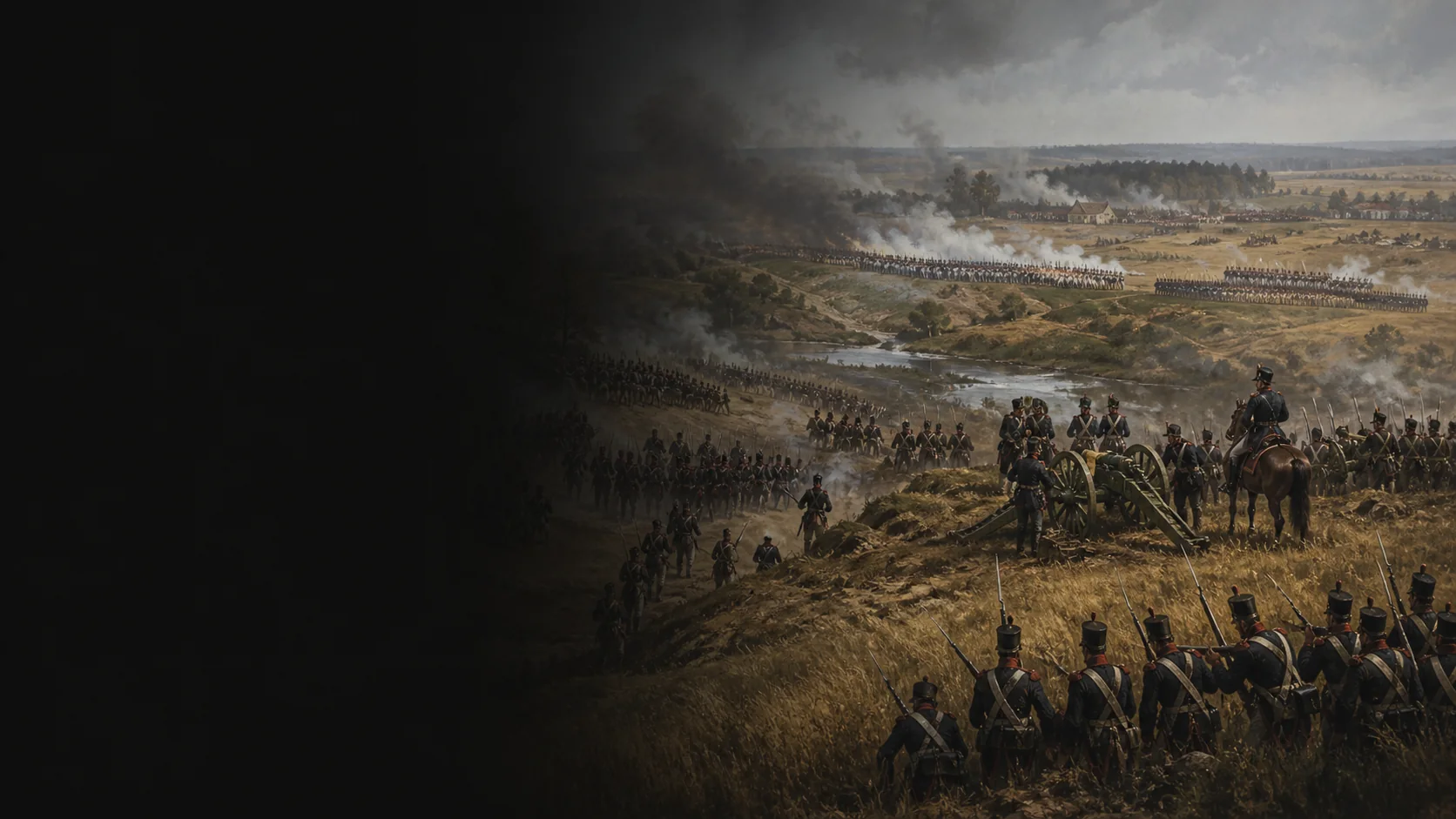
Borodino is a battle of attrition fought around strongpoints, ravines and crossings of the Kolocha. The French progressively capture the fortifications, but Russian counterattacks and depth turn each local gain into expenditure without destroying the army.

A position chosen to delay

Kutuzov chooses Borodino on the old Smolensk road, about 124 kilometres from Moscow. The Kolocha and several heights allow the defence to rest on fortifications without making every approach impassable.

Shevardino is an outpost

The action on 5 September captures the forward Shevardino Redoubt. Its loss forces the Russian left to contract towards the flèches, Semyonovskoye and the centre, but creates no operational breach.

The fortifications absorb the effort

The three Bagration flèches cover the southern approach to Semyonovskoye. Raevsky’s battery dominates the central height. These landmarks structure the battle, but the sources differ over the time and detail of each recapture.

A diversion, then a choice

Uvarov’s cavalry crosses the Kolocha on Kutuzov’s orders and threatens the French flank. It diverts forces and time without producing a decisive envelopment. Later, Napoleon commits artillery and infantry against the redoubt without throwing the Guard into the battle.

Military history

Sources

Primary archival sourceMikhaïl Koutouzov, rapport à Alexandre Ier sur Borodino, 1812

Notice d'archives, lignes 13–34 : Центральный государственный военно-исторический архив, fond VUA, dossier 3561, feuillets 52–58 ; édition dans Feldmarshal Kutuzov (1947), pp. 163–173.

Russian framework for the fighting, loss of Shevardino, defence and withdrawal; a command source preserved in an archival file.

View ↗
Primary reportAlexandre Mikaberidze, rapports de la bataille : Ouwarov à Barclay de Tolly, 3 [15] septembre 1812

Texte HTML, lignes 13–20 : ordre de Koutouzov, franchissement de la Kolocha avec la cavalerie, attaque près de Borodino, batterie abandonnée et diversion des forces françaises.

Uvarov’s diversion phase and the distinction among local success, French response and absence of decisive envelopment.

View ↗
Primary reportEugène de Beauharnais à Berthier, rapport du 10 septembre 1812

Texte HTML, lignes 13–29 : ponts de la Kolocha, attaque de Borodino à 5 h 30, redoute centrale, contre-attaques russes et assaut final.

French perspective on Borodino, Raevsky Redoubt and the sequence of attacks; times are compared with the syntheses.

View ↗
Official institutional sourceFondation Napoléon, chronologie de la campagne de Russie : de Borodino à Moscou

Page de chronologie, lignes 129–155 : choix de Borodino, ancienne route de Smolensk, ouvrages de Bagration et de Raïevski, attaque de Borodino, flèches, redoute, retraits et fourchettes de pertes.

Relational topography, general course, strength estimates and limits of the French victory.

View ↗
Official museum sourceMusée-Panorama de Borodino, batterie de Raïevski

Notice institutionnelle, lignes 62–117 et 137–148 : hauteur de Kourgane, batterie centrale, rôle du VIIe corps de Raïevski et concentration des attaques ; lignes 204–246 : contre-attaque de cavalerie au sud de la batterie.

Map landmarks, role of the central redoubt, Russian reinforcements and counterattacks.

View ↗
Official museum sourceMusée-Panorama de Borodino, hauteurs et flèches de Semionovskoïé

Notice institutionnelle, lignes 72–113 : trois fortifications, bois d'Outitsa et défense initiale de Vorontsov ; lignes 123–153 : attaques de Davout et Ney, reprises, blessure de Bagration et occupation française.

Geography of the flèches, sequence of assaults and a cautious limit on final occupation of the heights.

View ↗
Specialised modern studyFondation Napoléon, La bataille de la Moskowa par le général baron Lejeune

Article, lignes 75–85 : succession des attaques et refus de la Garde ; lignes 89–115 : croquis topographiques, point de vue et synthèse des scènes ; ligne 137 : approche depuis Borodino.

Specialised synthesis, comparison of accounts, cautious topography and distinction between a composed pictorial scene and tactical sequence.

View ↗
Specialised archaeological studyM. I. Gonyany et D. B. Solovyev, La batterie de Raïevski comme position d'artillerie

PDF, pp. 0–1, lignes 12–30 : objet archéologique et fourchette des témoignages ; pp. 5–8, lignes 139–170 et 195–210 : construction en deux temps, embrasures, emplacements et capacité estimée de 19–20 pièces.

Specialist check of the fortification and explicit treatment of disagreement over the number of guns; it is not used to invent a phase strength.
View ↗
Specialised modern studyAlexander Mikaberidze, The Battle of Borodino

Article d'introduction, lignes 13–19 : titre, auteur, place de Borodino dans la campagne et avertissement sur les estimations globales de forces et de pertes.

Independent specialised synthesis and identification of broad ranges; the numbers are not adopted as a single total.

View ↗
Specialised mapV. N. Kolesnik, plan spécialisé du champ de bataille de Borodino

PDF, pp. 1–7 : plan relationnel du champ de bataille, positions de Borodino, Kolocha, flèches, redoute de Raïevski et axes de la route de Smolensk ; consulté comme contrôle cartographique, sans conversion en coordonnées modernes.

Check of relational topography and axes before instructional placement in the viewBox.

View ↗

Edited by BattlesInMotion.com