1. Home
  2. Gunpowder & Empires
  3. Napoleonic Wars
  4. Trafalgar

Battle

Trafalgar

21 October 1805

Two columns, a broken line, isolated combats

Military history

How did Nelson accept fire on the approach in order to concentrate his fleet against the Allied center and rear?

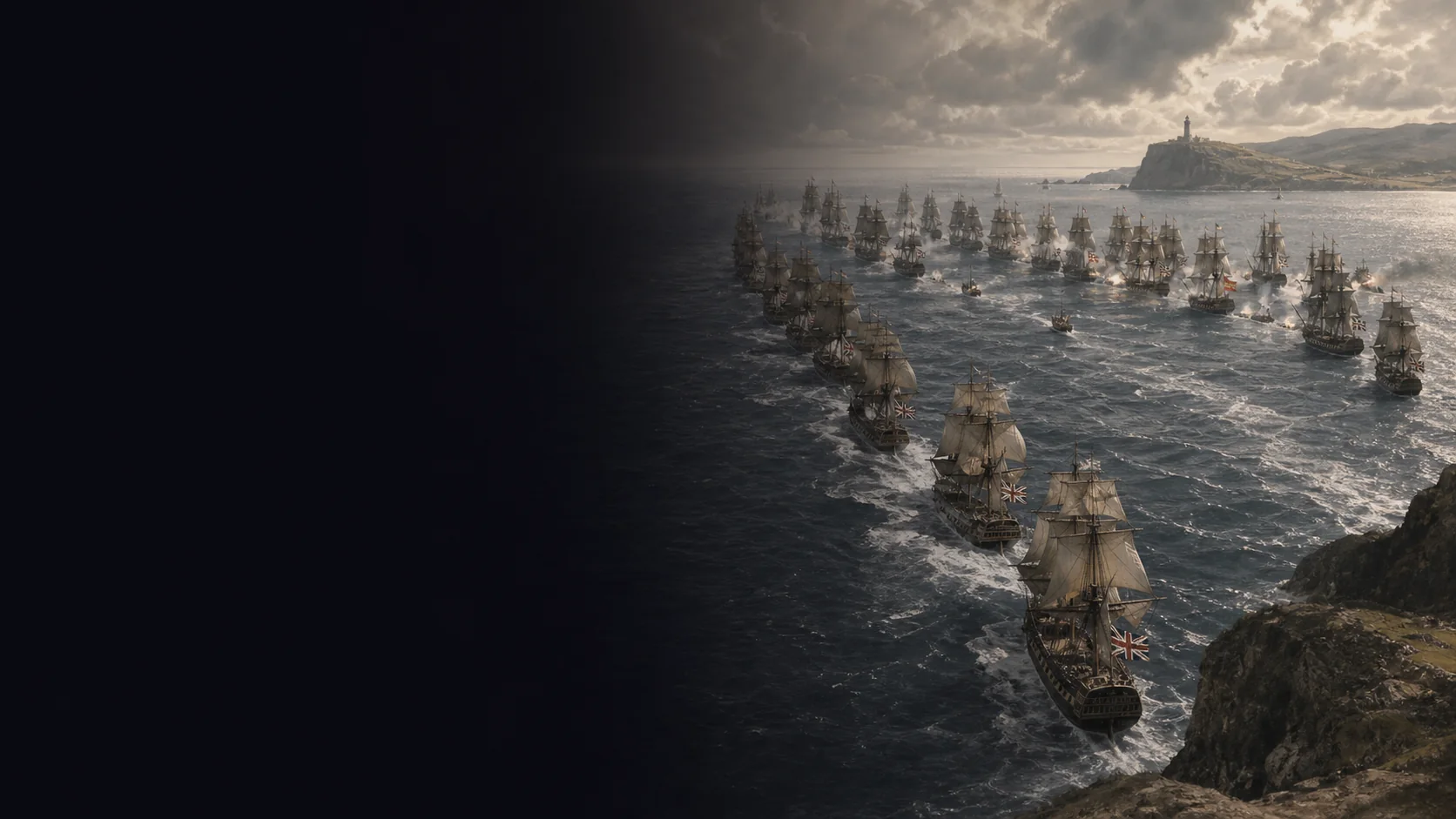
Off Cape Trafalgar, Nelson refuses to lose time forming a parallel British line. Two columns advance under fire toward the Franco-Spanish line: Collingwood reaches the rear, Nelson the center, and the following ships turn the breaches into close combat. Victory comes from local concentration and the Allied van's failure to support; it means neither that every British ship maneuvered as planned nor that the continental war was over.

A sortie constrained by the campaign

The Combined Fleet leaves Cádiz on 19 October after the invasion project against England has already been abandoned. Villeneuve is now ordered to reach the Mediterranean and support the operation toward Naples; contact off Cape Trafalgar on 21 October turns the sortie into a fleet battle.

The wind defines the problem

The light wind comes from west to west-northwest. The Allied line, close but irregular in its curve, heads north; the British, westward and to windward, can direct two columns toward it, but the leading ships must cross a long zone of fire before reaching a favorable firing position.

A coalition in line

The 33 Allied ships mix French and Spanish vessels. Villeneuve flies his flag in the center aboard Bucentaure; Gravina commands the rear from Príncipe de Asturias. The deployment is close and presents a second line or ships offset to leeward, but distances, nationalities and each division's ability to support the others are not uniform.

The British plan accepts risk

Nelson retains sailing order to avoid the delay of forming another battle line. Collingwood is to enter near the rear and Nelson to cut ahead of the center. A preparatory sketch also distinguishes a supporting division, but the attested action proceeds in two columns: the exact role of light vessels against the Allied van remains a reconstruction rather than a directly observed movement.

Military history

Sources

Published official primary source (London Gazette Extraordinary)Dispatches of Vice-Admiral Collingwood, London Gazette Extraordinary, issue 15858

London Gazette Extraordinary, issue 15858, pp. 1–3 : dispatches des 22 et 24 octobre ; amorces « at Daylight », « bear up in Two Columns », « The Action began at Twelve O'Clock », « Gravina, with Ten Ships », « strong southerly Wind » et « determined me to destroy » pour le contact, les ruptures, les survivants et la destruction des prises.

Primary source for chronology, line strength, Allied formation, rupture points, transfer of command and immediate consequences; its language of victory is placed in the context of its official function.

View ↗
Institutional synthesis (National Maritime Museum)Battle of Trafalgar Timeline

Sections « When and where did the Battle of Trafalgar take place? », « When did the Battle of Trafalgar start? », « What happened during the Battle of Trafalgar? » et « What happened after the Battle of Trafalgar? » : repères 11 h 50, 13 h 15, 15 h, 16 h 30, 17 h 30, captures, retours à Cadix et tempête.

Accessible chronology, column directions, rupture around Bucentaure, losses, captures, storm and distinction between maritime command and limited immediate effect on the war's course.

View ↗
Primary manuscript held by a maritime institutionSketch of the Battle of Trafalgar's plan

Notice du manuscrit BRP/6/1, rubrique « Object details » et description du croquis daté de 1805 : trois divisions britanniques, deux coupes de la ligne et division de soutien ; l'interprétation du diagramme supérieur y est dite incertaine.

Primary support for the attack plan and distinction between cutting the line and containing the unengaged portion; interpretation of the upper diagram remains explicitly uncertain.

View ↗
Institutional historical planAn Accurate Plan of the Three Positions of the British Fleet before Trafalgar

Notice de la planche PAI8830, description des trois positions de la flotte britannique à l'aube, à 9 h et juste avant l'action ; rubrique « Object details » pour l'auteur et la date du 17 décembre 1805.

Cartographic reference for the three approach positions and a check on caution over scale; the plate is not used to generate exact coordinates in the JSON.

View ↗
Specialist academic edition (Cambridge University Press)The Trafalgar Campaign: January–October 1805, in Nelson — The New Letters

Partie VI, « The Trafalgar Campaign: January–October 1805 », pp. 399–402 ; résumé de la campagne de dix mois, de la concentration française projetée et de la correspondance éditée par Colin White.

Strategic framework for the 1805 naval plan and safeguard against a teleological reading of Trafalgar as deciding the entire war.

View ↗
Institutional notice and campaign synthesis (National Maritime Museum)The Battle of Trafalgar, 21 October 1805

Notice de l'objet BHC0549, description de campagne : abandon du projet d'invasion, ordre donné à Villeneuve de gagner la Méditerranée et de soutenir Naples, puis interception britannique au large de Trafalgar.

Combined Fleet's operational mission in October 1805 and correction of the anachronistic reading that Trafalgar stopped an invasion project still under way.

View ↗
French primary report published in translationVilleneuve's Trafalgar despatch

Corps du rapport de Villeneuve : signal de virer vers Cadix, ligne de bataille resserrée, attaque britannique en deux colonnes et ordre adressé à l'avant de virer pour revenir au combat.

Allied tactical intent and distinction between the order for the van to return and its effective delay; checked against Gravina's report.

View ↗
Spanish primary report published in translationThe Trafalgar report by the Spanish Admiral, the Duke of Gravina

Corps du rapport attribué à Federico Carlos Gravina : passage daté de huit minutes avant midi, combats à portée de pistolet, abordages, ignorance revendiquée des mouvements de l'avant et secours du San Justo et du Neptune.

Contemporary Spanish perspective on rupture and melee; used to preserve the Allied observer's uncertainty rather than uncritically confirm the British account.

View ↗
Specialist naval-doctrine article (Proceedings, U.S. Naval Institute)Old Principles and Modern Applications — The Battle of Trafalgar

Section « The Battle of Trafalgar (1805) » : sous-parties sur les forces, le vent et les positions relatives, le plan de concentration, l'entrée « in echelon » et la reconstruction du changement de cap de Nelson.

Specialist interpretation of local concentration, the light squadron's role and maneuver alternatives; doctrinal judgments from 1914 are identified as modern readings, distinct from testimony of 1805.

View ↗
Institutional Franco-Spanish manuscript planFrench plan of the disposition of French and Spanish ships at Trafalgar

Notice de l'objet HSR/X/F, description du manuscrit daté du 21 octobre 1805 et de la disposition française et espagnole ; renvois au plan de Jonas Toby et au croquis tiré d'une lettre de Collingwood.

Independent check on the need for a dedicated naval map and coexistence of British and Franco-Spanish cartographic traditions.

View ↗
French institutional archival noticeBatailles navales — fonds Jean-Jacques-Étienne Lucas

Notice de la série « Batailles navales », rubrique de contenu : correspondances, rapport du capitaine Lucas sur la perte du Redoutable, états d'équipage, extraits de la Gazette et carte de position.

Institutional provenance of French documentation on Redoutable and a check on documentary limits: the JSON does not turn an unread archival notice into a detailed narrative.

View ↗

Edited by BattlesInMotion.com