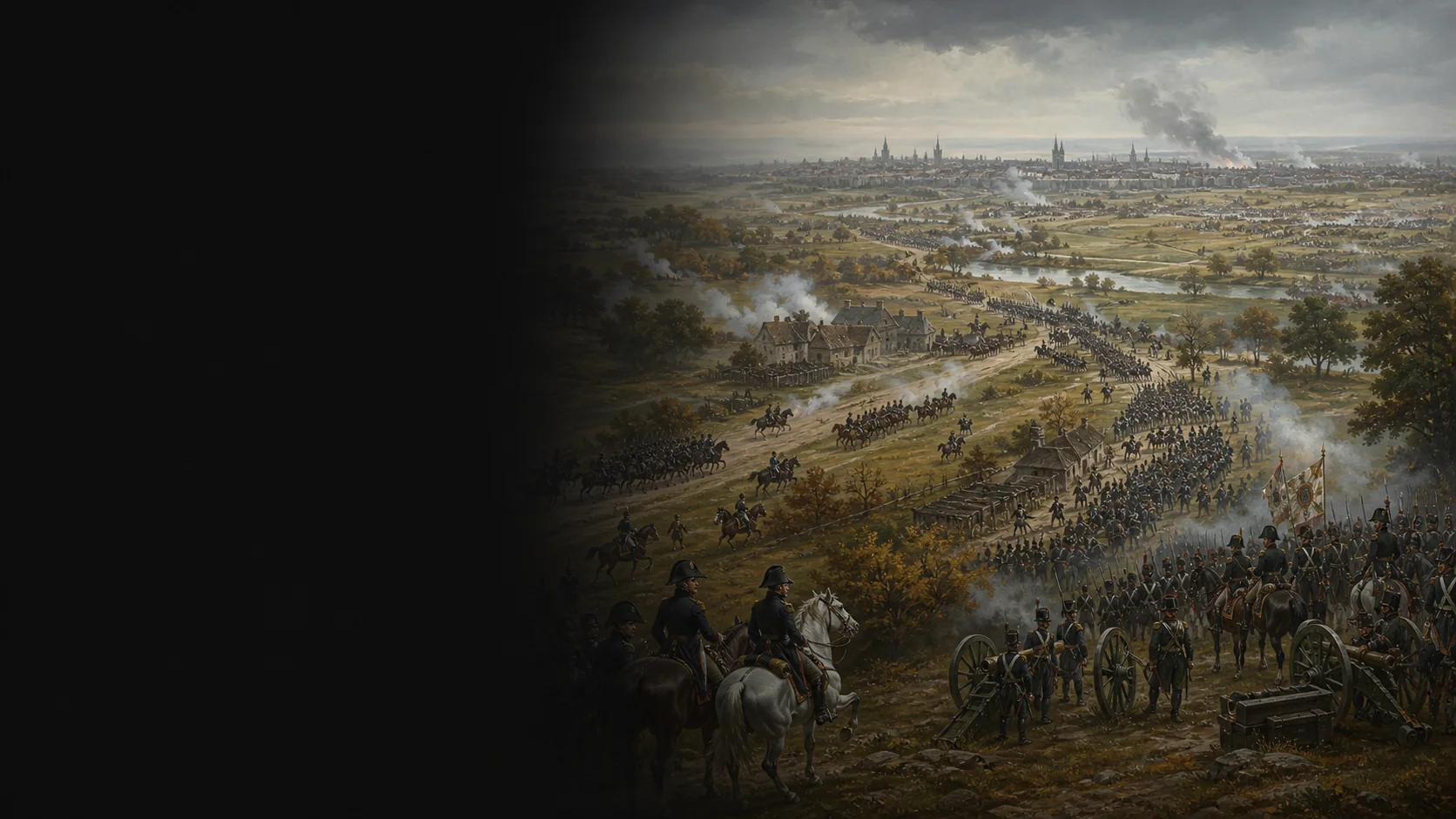
Concentrating around Leipzig
Napoleon gathered his corps around Leipzig to try to defeat the Army of Bohemia before all his opponents arrived. Roads radiated from the city, but the wooded valley to the west forced traffic through narrow crossings.
Battle
Three fronts to hold, one road out
Military history
On 16 October, Napoleon failed to break through south of Leipzig. Blücher pinned Marmont in the north, while Bertrand had to defend the road to Lindenau in the west. Allied reinforcements then made the French position increasingly difficult to hold. The retreat began during the night of 18–19 October. Much of the army crossed the western waterways, then the Elster bridge was destroyed too early: those still in the city lost their way out.
Napoleon gathered his corps around Leipzig to try to defeat the Army of Bohemia before all his opponents arrived. Roads radiated from the city, but the wooded valley to the west forced traffic through narrow crossings.
The assaults and counterattacks on the 16th produced no lasting breakthrough at Wachau. Meanwhile, Marmont fought in the north and Bertrand at Lindenau; these corps could not freely reinforce the main attack.
The relative pause on the 17th allowed Allied armies to close in. On the 18th, attacks multiplied in the north, east and south. Probstheida and Connewitz still held, but Napoleon no longer had the means to secure the decision he sought.
The retreat began during the night. On the 19th, fighting in Leipzig covered the army’s movement toward Lindenau. The bridge was destroyed before the evacuation ended, trapping part of the rearguard, wounded and baggage train.
Explore
Military history
Notice Z0075405, A/2815/2009 : transcription partielle dans Beschreibung des Textes, lettre datée du 23 octobre 1813.
Contemporary testimony by a Prussian officer on the battle of the 18th, Napoleon's confinement in Leipzig, and the assault on the 19th; used cautiously because it mainly describes his battalion and viewpoint.
View ↗Édition Ackermann, 1814 : pp. 1–4 (portée), 27–29 (fronts du 16), 37–43 (défection, repli et assaut urbain) ; autres passages hérités.
Contemporary check of the fronts visible from Leipzig, urban terrain, and constrained passages; figures and political judgements are checked against modern syntheses.
View ↗Section La bataille de Leipzig : concentration, journées des 16, 17 et 18, puis 19 octobre : Défaite française et retraite.
Chronological anchor and check of the mechanism closing the retreat; casualty estimates are retained as disputed.
View ↗Entrées « 8–11 octobre », « 13 octobre », « 14 octobre » et « 16–19 octobre » : hésitation à Düben, convergence sur Leipzig, quartier général à Reudnitz et retraite par le pont de l'Elster avant sa destruction.
Check of French concentration decisions and withdrawal chronology, without turning an editorial chronology into a complete order of battle.
View ↗Page de l'exposition, paragraphe « Museum zur Völkerschlacht bei Leipzig » : diorama de 15 m² reconstruit à partir de descriptions contemporaines.
Institutional check on the use of contemporary descriptions to reconstruct a village and on the representation's educational character.
View ↗Recherchetext de Leipzig Travel : paragraphes « Oktober 1813 » et « Am 18. Oktober » sur la convergence, Möckern/Lindenau, le raccourcissement vers Leipzig, Paunsdorf, la défection saxonne et le pont de l'Elster.
Institutional cross-check of the 14–19 October sequence and relationships among villages, town, Saxon defection, and withdrawal.
View ↗Introduction bibliographique de John H. Gill, référence héritée ; le corps du texte n’a pas été récupéré lors de cette reprise.
Bibliographic orientation. New strength figures rely on Millar and syntheses actually reviewed.
View ↗Cambridge History of the Napoleonic Wars, chapitre 23, résumé en ligne : plan allié, épuisement de l'armée française, encerclement à Leipzig, début le 16, retraite le 19 et perte de l'Allemagne ; édition pp. 471–491, DOI 10.1017/9781108278096.024.
Operational perspective and check of the inference that exhaustion and Allied convergence reduce French options before the final decision.
View ↗Leipzig1813.de, page titrée « Das Gefecht von Wachau und Connewitz » : paragraphes sur l'attaque de 8 h, les reprises de Wachau, Markkleeberg, Liebertwolkwitz et l'engagement des réserves.
Specialist detail on the southern fighting and boundary among local success, counterattack, and absence of breakthrough.
View ↗Leipzig1813.de, page titrée « Das Gefecht bei Lindenau und Möckern » : stratégie de Gyulai, engagement de Bertrand, décision de Blücher, attaque de Yorck sur Möckern et repli de Marmont.
Specialist detail on the northern front and causal evidence that Marmont is held there instead of joining the southern battle.
View ↗Article complet Der Tag der Entscheidung : colonnes, Probstheida, Paunsdorf, défection et choix du repli.
Detailed check of the concentric attack on the 18th and bounding the Saxon defection as a local effect rather than sole cause.
View ↗The Napoleon Series : introduction et sections « French Order-of-Battle », désaccords sur les effectifs et unités provisoires, défection saxonne du 18 et pont de Lindenau détruit le 19.
Define the mapped formations, verify the presence of France's allied contingents, and avoid treating one order of battle as certain.
View ↗Notice DDB : description de la carte et de ses marquages colorés des mouvements russes, prussiens, autrichiens et napoléoniens ; lieux, formations et date dans les champs « Bezug » ; inventaire S/817/2003.
Heritage anchor for relationships on the southern front and place names; the dossier map deliberately simplifies this density.
View ↗Plan II, édition de 1852, environ 1:50 000 ; premier feuillet du fac-similé effectivement examiné, second feuillet blanc.
Check of spatial relationships among Leipzig, the Möckern and Wachau fronts, and withdrawal axes; a later source used as a comparison map, not contemporary observation.
View ↗The Regulation Uniform : shako couvert, kollet, parements, buffleteries, capote et fusil ; variantes des réservistes.
Depiction of a regular musketeer; do not assign this uniform to all Prussians in 1813.
View ↗Die Regiments-Uniformen im Laufe der Zeit : tenues grises et habits bleus au shako coexistent en 1813.
Institutional check on the variety of Prussian uniforms.
View ↗Équipement et habit de campagne ; lecture effectuée lors de Wagram dans cette reprise.
Reuse of a shako and campaign-coat silhouette, without implying every battalion dressed identically.
View ↗Notice de reconstitution de 2011, équipement de 1812 : lecture effectuée lors de Borodino dans cette reprise.
Reuse of a cuirassier silhouette with crested helmet, cuirass and straight sabre.
View ↗