1. Home
  2. Gunpowder & Empires
  3. Napoleonic Wars
  4. Jena–Auerstedt

Battle

Jena–Auerstedt

14 October 1806

Two fields · one divided Prussian army

Military history

How did Jena and Auerstedt turn a poorly coordinated Prussian march into a campaign defeat?

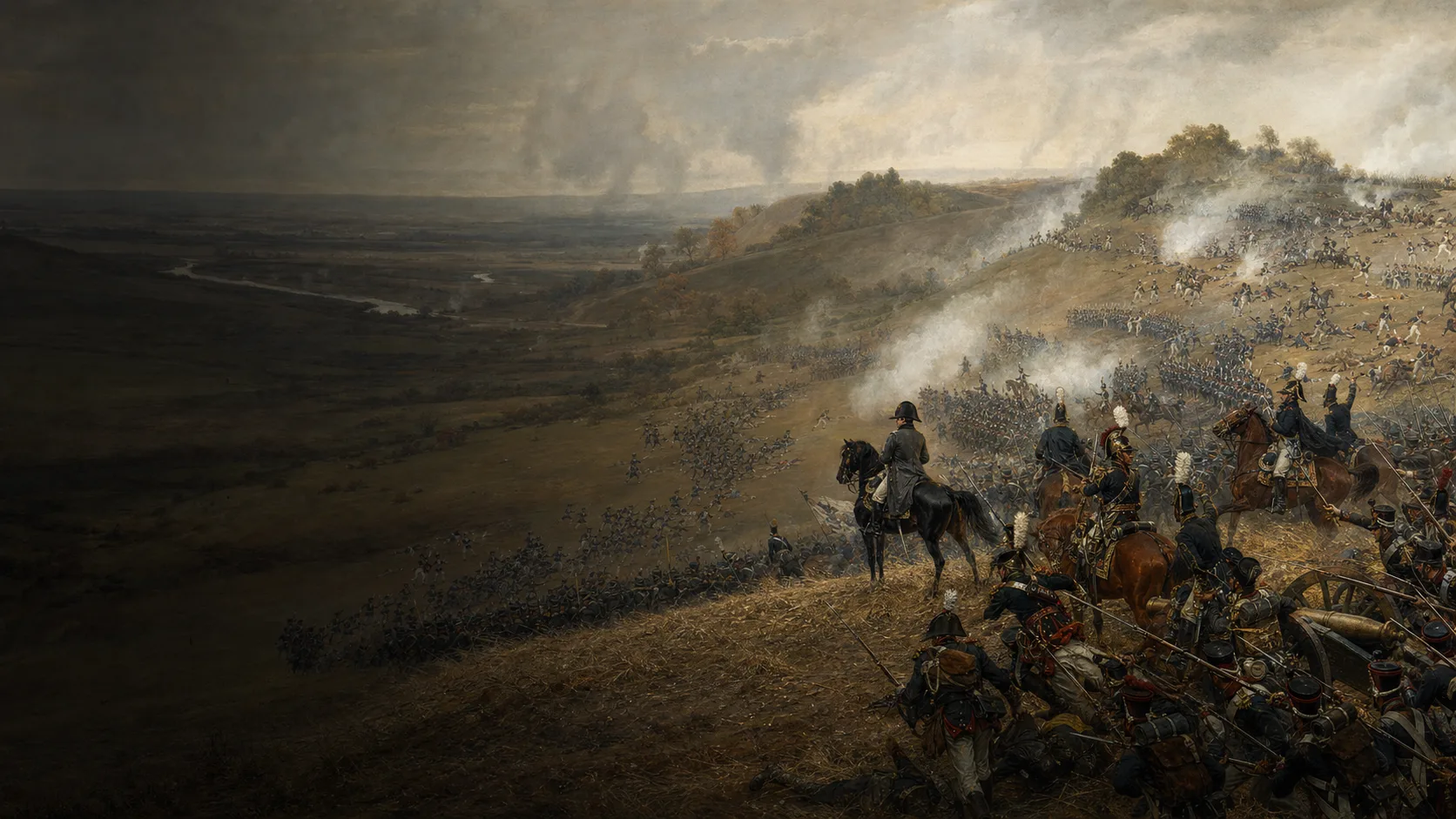
On 14 October 1806, the Grande Armée fought not one battle but two distinct engagements, at Jena in the south and Auerstedt in the north, both west of the Saale. Napoleon fixed and drove back Hohenlohe's force in the south while Davout's heavily outnumbered III Corps met the main Prussian army around Hassenhausen. French victory came from the progressive convergence of corps at Jena and Davout's ability not to yield before Prussian command could use its superiority.

Prussia forces the clash

After the Prussian ultimatum of 26 August, the declaration of war on 9 October opened a campaign Berlin wanted to conduct before Russian reinforcements arrived. The Grande Armée was already deployed in central Germany; French marches and the Prussian change of direction brought both armies toward the Saale crossings.

One day, two Prussian armies

On the eve of battle, Hohenlohe covered Jena with a force that was not the whole Prussian army. Brunswick and the king were farther north, around Auerstedt and the Naumburg–Kösen roads. Contemporary reports and campaign maps require this separation to be preserved in reading the battle.

The Saale and the heights

Napoleon moved toward Jena and had an artillery road opened on the Landgrafenberg during the night. Davout, coming from Naumburg, had to emerge through Kösen and cover the French deployment in the north. Roads, plateaux, and fog made opposing intentions difficult to read, especially between the two fields.

The command problem

At Jena, Napoleon first committed the available troops before bringing reinforcements together. At Auerstedt, Brunswick had to coordinate a larger army in a battle he did not necessarily expect to fight there; his early wounding deprived the line of common direction. Responsibility remains disputed between interested accounts and modern studies.

Military history

Sources

Primary source and digitised archival collectionDer Untergang des alten Preußen: Jena und Auerstedt; Quellenberichte, éd. Horst Kohl

University of Potsdam Digital Collections, table des matières et fac-similés: rapport de Marwitz p. 32; 5e Bulletin p. 66; rapport de Frédéric-Guillaume III p. 77; rapport de Scharnhorst p. 91; rapports/lettres de Scharnhorst, Blücher et Kalckreuth pp. 109–119.

Contemporary Prussian reports, reproduced French bulletin, and bounds on interested narratives; separation of the two fields and command at Auerstedt.

View ↗
Digitised institutional historical planPlan zur Schlacht bei Jena am 14. Oktober 1806

University of Potsdam Digital Collections, fac-similé du plan de la bataille d'Iéna, page de plan dans le recueil des sources.

Place names and spatial relationships on the Jena field; check on its separation from Auerstedt.

View ↗
Digitised institutional historical plansPläne zur Schlacht bei Auerstedt am 14. Oktober 1806

University of Potsdam Digital Collections, fac-similés des plans d'Auerstaedt dans le même recueil, pages de plan après les rapports.

Kösen, Hassenhausen, Auerstedt, and Davout's exit; check on schematic geography.

View ↗
Reproduced contemporary official bulletinCinquième Bulletin de la Grande Armée, Jéna, 15 octobre 1806

Napoleon-Empire, reproduction du 5e Bulletin: sections position du 13 octobre, débouché d'Iéna, action d'Auerstaedt, résultat et poursuite, paragraphes web consacrés au bulletin.

French march, artillery road, positions of Davout and Bernadotte, claimed official course, and exploitation; loss and prisoner figures are explicitly treated as claims.

View ↗
Specialist institutional synthesisIéna–Auerstedt, 14 octobre 1806

Fondation Napoléon, Itinéraires: contexte et déclaration de guerre; arrivée de Napoléon au Landgrafenberg et nuit du 13 octobre; déroulé d'Iéna autour de Vierzehnheiligen; Auerstedt, Hassenhausen, Brunswick et Davout.

General chronology, role of the Landgrafenberg, reading of the Jena lines, and effect of Brunswick's wounding at Auerstedt.

View ↗
Official municipal history19th century: Jena in 1806

Stadt Jena, page officielle d'histoire locale, section du XIXe siècle consacrée au 14 octobre 1806 et aux forces réunies autour de Vierzehnheiligen.

Institutional confirmation of the double battle, Landgrafenberg, and local geographical frame; municipal strengths are not used as the reference total.

View ↗
Specialist university thesisThe Prusso-Saxon Army at Jena-Auerstädt: A Reassessment

University of North Texas Digital Library, thèse de Roger S. Hallmark (1995), description, introduction méthodologique et chapitres sur l'armée et les batailles, pp. ix–x et 1–259.

Interpretive boundary: defeat cannot be reduced to supposed obsolescence of Prusso-Saxon soldiers or tactics; distinguish combat performance from operational coordination.

View ↗
Specialist historical synthesisLa bataille d'Iéna et d'Auerstaedt

Napoleon-Empire, sections Situation générale, Forces, Positions, Préliminaires, Combats, Exploitation et Conséquences; passages sur Lannes, Hohenlohe, Rüchel, Davout, la poursuite et les capitulations d'octobre–novembre 1806.

Sequence of engagements, strength bounds, and campaign consequences; secondary figures are retained as scope-dependent estimates.

View ↗
Specialist order of battleOrder of Battle: Auerstadt, 14 October 1806

The Napoleon Series, ordre de bataille d'Auerstaedt: introduction sur le IIIe corps et l'armée prussienne, puis rubriques Davout, divisions de Gudin, Friant et Morand.

Orders of magnitude and composition of III Corps; used cautiously because present, engaged, and available are not identical categories.

View ↗
Institutional military atlasThe Jena Campaign

United States Military Academy, Digital History Center, index The Jena Campaign: cartes du déploiement, situations des 12–14 octobre, plan de minuit du 13 et cartes de poursuite jusqu'à l'Oder.

Cartographic structure of the campaign, sequence from pre-contact through two fields to pursuit, and control of operational relationships; no unnecessary detailed reading is invented from the images.

View ↗
Institutional historical mapUebersichts Blatt zu den Schlachten bei Jena und Auerstädt am 14ten October 1806 / Carte Synoptique

Gottfried Wilhelm Leibniz Bibliothek, notice de la Carte Synoptique: titre et titre alternatif; Karlsruhe, 1831; lithographie; échelle env. 1:80 000; collection GWLB Altkarten et institution détentrice.

Institutional check on the synoptic map and choice of a relational representation over false geodetic precision.

View ↗
Institutional study of operational historyDavid G. Chandler, Napoleon, Operational Art, and the Jena Campaign

U.S. Army Center of Military History, Historical Perspectives of the Operational Art, CMH Pub 70-89, chap. 1, pp. 44–62; notamment pp. 50–52 (ordres et concentration), carte pp. 54–55, pp. 58–59 (marche et bataille d'Auerstaedt), p. 61 (collision des retraites).

Geography of the two fields, Davout's westward march from Naumburg, Weimar–Jena–Auerstedt–Kösen–Saale relationships, rupture, and collision of the retreats near Apolda.

View ↗

Edited by BattlesInMotion.com