1. Home
  2. World Wars
  3. Second World War
  4. Second Battle of El Alamein

Battle

Second Battle of El Alamein

23 October — 11 November 1942

From minefields to breakthrough: victory built through attrition

Military history

How did Eighth Army turn its superiority in resources into a breakthrough through mines and antitank defenses?

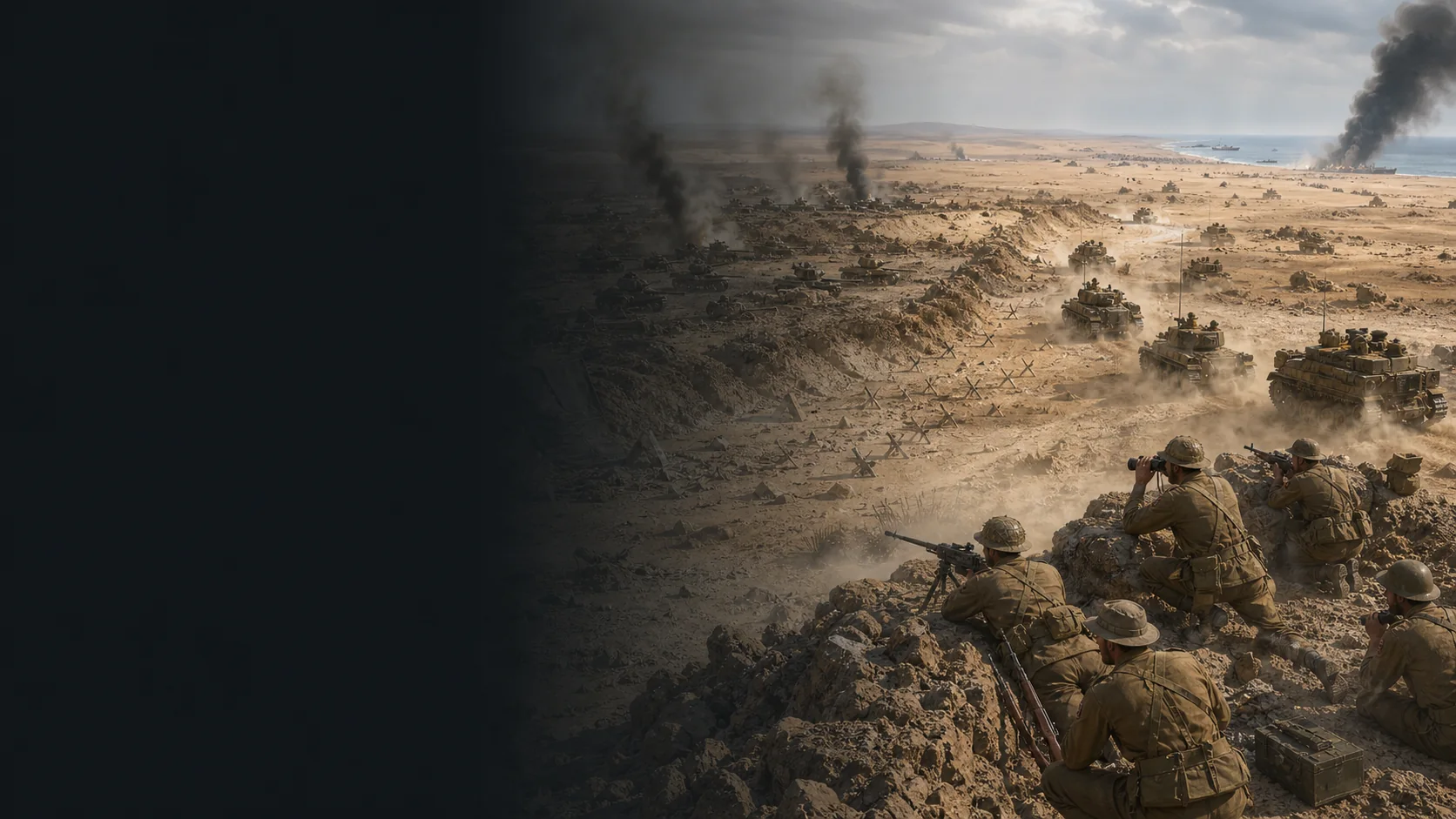
The Second Battle of El Alamein does not begin with a tank breakthrough: Eighth Army must first cross mine belts, maintain pressure in two sectors and deny Axis armor room to maneuver. Lightfoot gains ground for the infantry, but corridors remain congested and covered by antitank guns. Diversion, attrition, artillery and air power make Supercharge possible; the rupture from 2 to 4 November forces a withdrawal without annihilating the entire mobile force. The scope extends the pursuit to 11 November to respect the catalog entry.

The geographical lock

The sea and Qattara Depression close the major routes for mechanized outflanking. The Axis can therefore concentrate a static defense across a mined front while the Allies must open corridors before employing their armored mass.

Making superiority usable

Eighth Army enjoys a substantial material and air advantage, but that advantage does not convert itself into movement. Engineers, artillery, intelligence, communications and training must turn narrow passages into routes usable by tanks.

Lightfoot opens corridors; the front holds

On the night of 23 October, infantry reaches several objectives and the 2nd New Zealand Division takes Miteiriya Ridge. Armored exploitation nevertheless meets mines, congestion and antitank guns; the initial success creates a foothold, while emergence into the depth remains to be built.

Attrition prepares Supercharge

Pressure in the north, Axis counterattacks and air action wear down reserves without immediately deciding the battle. Montgomery then shifts the rupture point south; Supercharge repeats the idea of infantry opening the way, but with an objective and deployment adapted to what Lightfoot has revealed.

Military history

Sources

Official history and archives, Australian War MemorialBarton Maughan, Tobruk and El Alamein, chapitre 14, “Launching the Battle”

PDF, pp. 639–646 ; pp. 639–642 pour le rassemblement, les effectifs et la contrainte de ravitaillement ; pp. 642–645 pour la défense minée et Operation Lightfoot ; pp. 645–646 pour les couloirs de sape et les hypothèses sur les antichars.

Allied preparation, order of magnitude of tanks and aircraft, depth of minefields, division among XXX/XIII/X Corps and function of the corridors.

View ↗
Official history and archives, Australian War MemorialBarton Maughan, Tobruk and El Alamein, chapitre 15, “The Dog Fight”

PDF, pp. 677–684 ; pp. 677–679 pour les objectifs du premier soir et l’exploitation blindée manquée ; pp. 680–682 pour les contre-attaques et les liaisons ; pp. 682–684 pour les canons de 88 mm, la 9th Armoured Brigade et les pertes au sud.

Limits of Lightfoot, congestion, antitank fire, counterattacks, cost of exploitation and distinction between bridgehead and rupture.

View ↗
Institutional source, National Army MuseumThe Battle of El Alamein

Page, lignes 48–52 et 64–80 pour les forces, le ravitaillement et la défense ; lignes 92–115 pour Lightfoot, Supercharge et le retrait ; lignes 139–144 pour la portée et les limites du récit de tournant.

Strategic context, comparative estimates, Lightfoot–Supercharge sequence, withdrawal and warning against monocausal explanation.

View ↗
Institutional source, Manatū Taonga Ministry for Culture and HeritageEl Alamein | NZ History

§ “Breakthrough at El Alamein”, lignes 14–24 : début le 23 octobre, barrage d’environ 900 canons, objectifs d’infanterie, congestion, Supercharge, carburant, retrait et captures.

Narrative chronology of Lightfoot and Supercharge, role of the 2nd New Zealand Division and reach of the retreat.

View ↗
Institutional source, Manatū Taonga Ministry for Culture and Heritage2 New Zealand Division leads breakthrough at El Alamein

Page, lignes 10–13 : attaque à 1 h 05 le 2 novembre, deux brigades britanniques avec la 2e division néo-zélandaise, chars allemands, carburant bas et retrait au 4 novembre.

Composition and purpose of Supercharge, tank fighting, fuel exhaustion and withdrawal of the mobile force.

View ↗
Institutional chronology, Manatū Taonga Ministry for Culture and HeritageThe North African Campaign timeline

Page, entrées des 21 septembre au 13 novembre 1942, lignes 72–82 : commandement de Montgomery, Lightfoot, mort de Stumme, retour de Rommel, Supercharge, Torch et sortie d’Égypte.

Command window and chronological boundaries for the battle, Torch and pursuit.

View ↗
Official USAAF chronology, operational sourceCombat Chronology, 1941–1945, entrées USAMEAF

PDF, pp. 62–65 ; entrées des 28 octobre au 5 novembre 1942 : perturbation des contre-attaques, pression de la 9th Australian Division, Supercharge et Rahman Track le 2 novembre, plus de 400 sorties contre la retraite les 3–4 novembre.

Documented air role in support, route interdiction, Supercharge and pursuit; the map does not turn these missions into a sole cause.

View ↗
Academic article, Journal of Military and Strategic StudiesJonathan Fennell, “Steel my soldiers’ hearts”: El Alamein Reappraised

Résumé et notice d’auteur, Vol. 14 No. 1 (2011), lignes 28–35 : débat commandement/matériel, crise puis redressement du moral et interprétation combinée.

Historiographical dispute over Montgomery, matériel and morale; the JSON retains cumulative causality.

View ↗
Institutional cartography, NZ HistoryEl Alamein campaign map, 1942

Légende et carte de campagne : relation entre le littoral méditerranéen, la ligne d’El-Alamein et la dépression de Qattara ; utilisée comme contrôle topologique, avec une fonction distincte de celle d’un relevé de coordonnées.

General diagram orientation and separation among positional battle, rupture and westward pursuit.

View ↗

Edited by BattlesInMotion.com