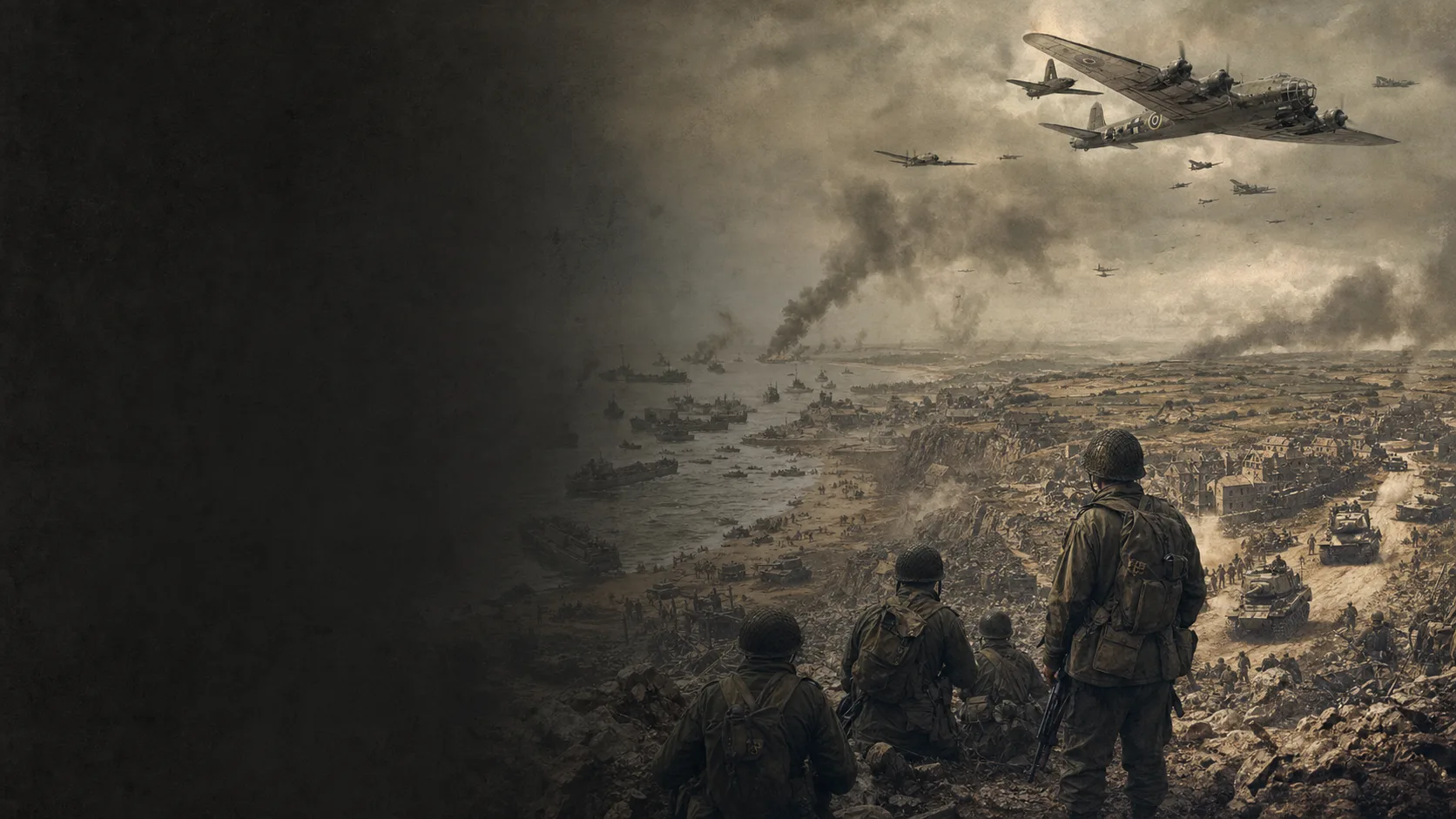
A global war won by coalitions able to connect fronts, production and transport
Military history
The strategic problem
The Second World War did not begin in 1939 with two already complete coalitions. Alliances expanded, priorities changed and every theatre demanded resources needed elsewhere. The Axis initially secured rapid decisions through concentration and surprise. The Allies eventually linked production, maritime transport, intelligence, air power and simultaneous offensives—without every local victory by itself marking a global turning point.
Axis expansion
Poland, France, the Balkans and the Japanese offensives demonstrated the power of concentrated operations. But Britain remained at war, the Battle of the Atlantic continued and the invasion of the USSR abruptly lengthened the front. The British carrier raid on Taranto took place as early as the night of 11–12 November 1940, not during the war's final phase.
The initiative becomes contested
The Axis could still win locally, as at Gazala, but could not protect all its lines or readily replace losses. Midway cancelled a Japanese offensive; El Alamein and Stalingrad halted advances; Guadalcanal opened a war of attrition in which command of the sea remained uncertain for a long time.
Allied convergence
The Allies combined production, intelligence, bombing, amphibious landings and ground offensives. Kursk, Imphal–Kohima, Bagration, the 1944 landings and the final campaigns formed a cumulative pressure across several theatres. In Western Europe, command of the sea and air made the landings possible; most German forces nevertheless remained committed against the Soviet Union.
Official historyMaurice Matloff (dir.), American Military History, chapitres 20 à 23
chs. 20–23
Initial Axis expansion, American mobilisation, coalition priorities, Allied commands, and the transition from defensive phases to offensives in Europe and the Pacific.