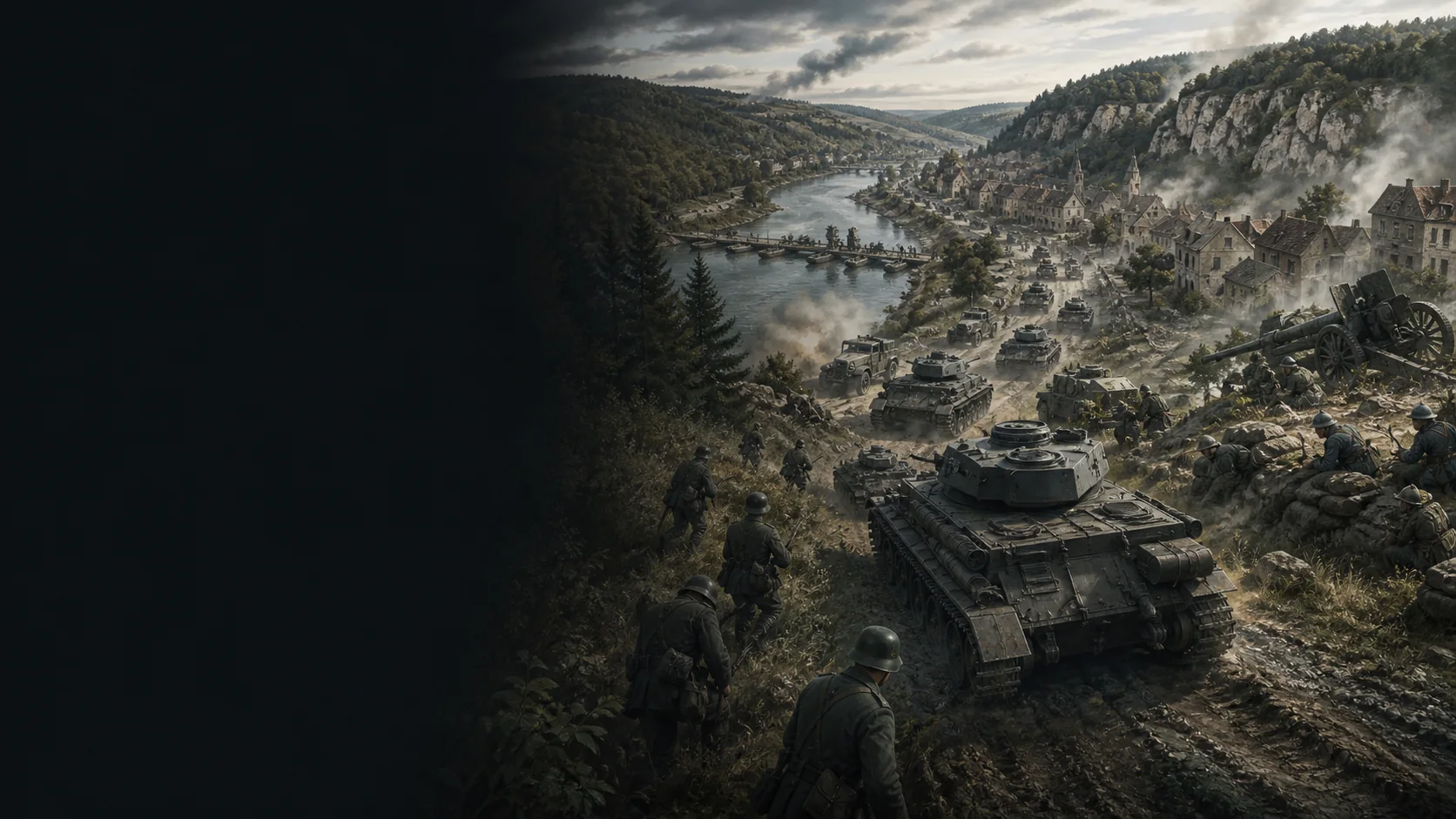
Cross the Meuse before the defence can reconstitute itself
Military history
How do the Meuse crossings become an operational breakthrough before the French reserves arrive?
At Sedan, German infantry crosses the Meuse before the tanks. On 13 May, bombardment and assault create a bridgehead that engineers connect to the starting bank. Armour crosses before French reserves can intervene together. The local counterattack at Bulson fails; the 1st and 2nd Panzer Divisions can turn west while the 10th protects the southern flank. The outcome rests on this sequence of crossings, support and reactions that turns the breach into an exploitation route.
The German operational gamble
The German plan concentrates a major effort by Army Group A in the Ardennes. A rapid arrival at the Meuse is intended to surprise the Allied deployment, enable a crossing and then open an advance west. Roads and communications make this concentration possible while leaving long columns vulnerable to delay.
Defending the Meuse
French X Corps holds an extended sector around Sedan. The Category B 55th Division is not an empty shell: the AUSA study places it at about 80–85 per cent of establishment, with roughly 13,000 men and 174 guns, while the 71st Division is only partly in position when the blow falls. Depth, armoured reserves, and artillery exist, but linking them is slow.
From fire to bridges
On 13 May, German action combines bombardment, infantry assault at several sites, and engineer crossings. The 2nd Panzer's assaults at Donchery and the 10th's at Wadelincourt are initially contained; the 1st Panzer's two crossings west of Sedan open the decisive breach. Air effects on communications, artillery, and morale matter, but the sources do not support reducing the breakthrough to the physical destruction of bunkers by Stukas.
The lost French moment
On 14 May, the 7th BCC and 213th RI counterattack towards Bulson, while the commitment of the 3rd DCr, although ordered into the sector, is delayed and then fragmented. Fuel, orders, communications, and support do not combine into a single blow capable of throwing the Germans back across the Meuse. The map shows the local action actually undertaken, not a fictitious offensive by the entire 3rd DCr.
Specialist institutional studyRobert A. Doughty, Studying the Operational Level of War: A Staff Ride to Sedan (1940), Army History
Army Historian 12, octobre 1988, PDF pp. 3–5 relues : Semois, relève de la 71e, infanterie le 13, pont puis blindés le 14, réaction française et tournant vers l’ouest. OCR imparfait ; détails divergents non arbitrés par ce seul article.
Crossing chronology, role of X Corps, bridge sequence, French counterattack, and effects of air coordination.
Institutional military studyThe Fall of France and the Summer of 1940, Landpower Essay 55, Association of the United States Army
PDF, pp. 12–17 : forces et doctrines; défense de Sedan; 55e division et 147e régiment de forteresse; franchissements de Wadelincourt, Gaulier et Donchery; rupture et exploitation.
Orders of magnitude for the 55th Division, distribution of the Panzer divisions, crossing sites, radios, artillery, and operational consequence.
Specialist institutional studyCenter of Military History, Historical Perspectives of the Operational Art
PDF, section Sedan pp. 108–109 et étude Panzer Group Kleist pp. 184–186 : axes des trois Panzer, succès des passages de la 1re Panzer, ponts nocturnes et exploitation vers l'ouest.
Independent check of the approach through the Ardennes, unequal crossings, and division of labour between the westbound 1st–2nd Panzer and the 10th Panzer on the southern flank.
Secondary synthesis mapWikimedia Commons, Slaget ved Sedan (12. mai 1940)
Aperçu 960 × 1180 entier examiné ; boucle de Glaire–Gaulier et Meuse vers Wadelincourt. Fond moderne OSM, relations seulement, aucun calque.
Cartographic check of north–south relationships: German approach axes, east–west course of the Meuse, Sedan, Donchery, Wadelincourt, and the French heights.
Institutional sourceDeutsches Historisches Museum, Vorstoß durch die Ardennen 1940
Page LeMO, paragraphes sur le plan de Sichelschnitt et la surprise dans les Ardennes; section de campagne indiquant le franchissement de la Meuse à Sedan le 13 mai et l'ouverture de l'arrière vers la Manche.
Documented operational objective, Ardennes Schwerpunkt, and significance of the Sedan crossing.
Specialist monographRobert A. Doughty, The Breaking Point: Sedan and the Fall of France, 1940
Google Books, table des matières et chapitres : The German Fight in the Ardennes, p. 33; The French Fight in the Ardennes, p. 73; French Defenses Along the Meuse, p. 101; chapitres suivants sur Sedan.
Specialist framework for the Meuse defences, Sedan units, Bulson heights, and dispute over the causes of the breakthrough.
Specialist synthesisKarl-Heinz Frieser, The Blitzkrieg Legend: The 1940 Campaign in the West
Google Books, table des matières : The 1940 Ardennes Offensive; Breakthrough of Panzer Corps Guderian at Sedan; Collapse of Meuse Front; Push to Channel Coast and Problem of Exposed Flank.
Modern interpretation of the breakthrough, relationship between Sedan and the race to the Channel, and caution towards a technological Blitzkrieg narrative.
Google Books, section The campaign in the West; mémoire de commandement publié en 1952, à confronter aux études institutionnelles et à la recherche de Frieser.
German command perspective; pre-existing reference, not re-read during this visual revision.
Official French sourceDirection du patrimoine, de la mémoire et des archives, La bataille de Stonne-Oches, 13 mai–10 juin 1940
Page Chemins de mémoire, sections Le XIXe corps à Sedan, Le premier choc sur la Meuse, La Meuse est franchie le 13 mai et La contre-attaque française du 14 mai.
French command chain, 55th and 71st Divisions, 3rd DCr, crossing on 13 May, and attempted counterattack.
Fiche et photographie 2560 × 1920 entières examinées.
The support tank’s shape, welded armour and armament. Preserved vehicle 30070 came from the 4th BCC; the generated image evokes the type without copying that attribution.