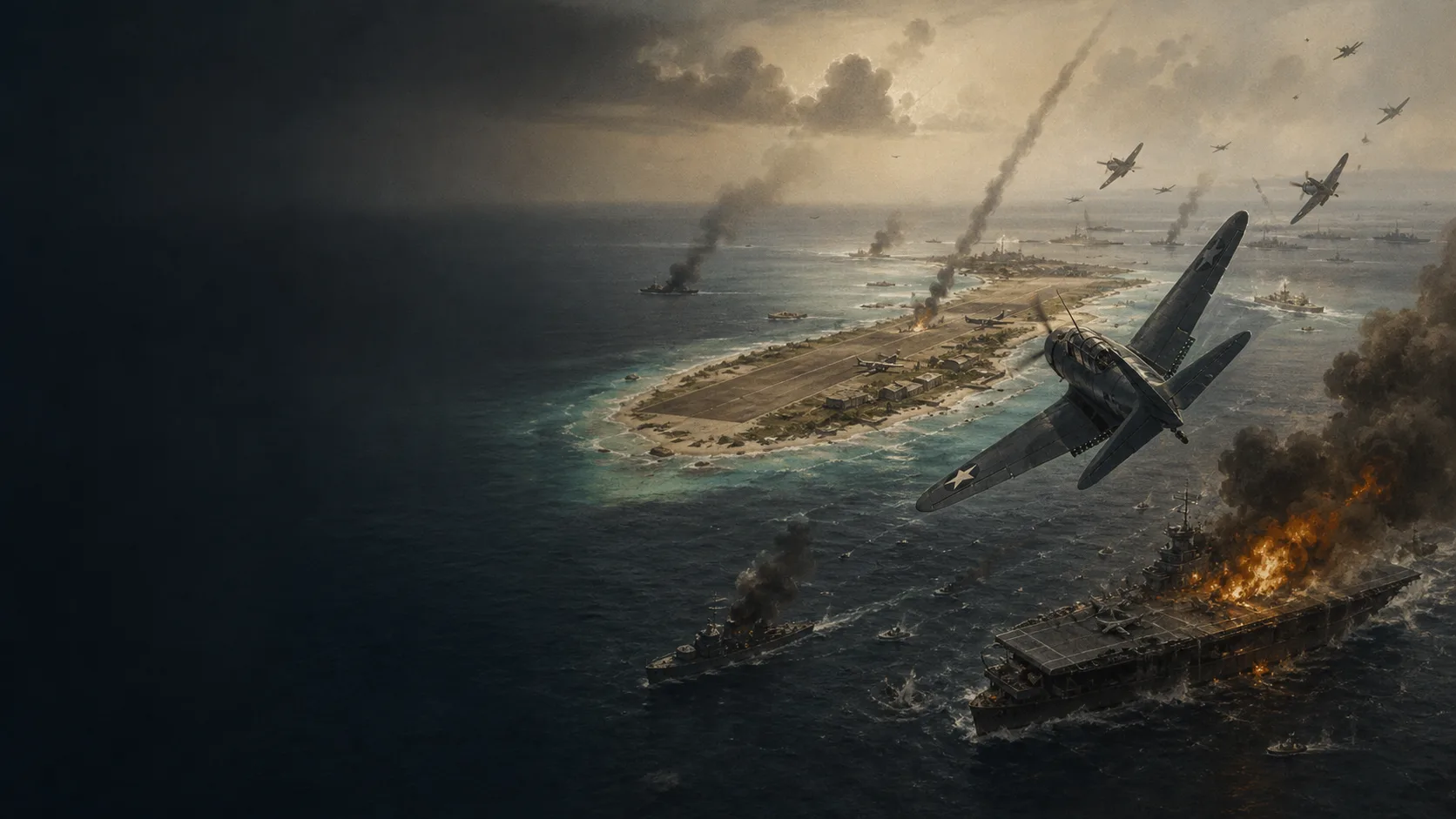
After Pearl Harbor
Yamamoto seeks to capture Midway and provoke the decisive battle against the American carriers. His plan, however, disperses Japanese forces across a vast area and assumes that surprise will endure.
Battle
Intelligence positions the ambush; disordered attacks finally open the breach
Military history
Nimitz knows that a Japanese operation is targeting Midway and positions his three carriers northeast of the atoll. Yet he knows neither when his aircraft will find Nagumo nor whether the dispersed groups will arrive together. Nagumo, meanwhile, must strike Midway, recover his aircraft, maintain a combat air patrol, and prepare a response against carriers that he locates only belatedly.
Yamamoto seeks to capture Midway and provoke the decisive battle against the American carriers. His plan, however, disperses Japanese forces across a vast area and assumes that surprise will endure.
American analysts connect the code AF with Midway and identify the objective, time frame, and part of the order of battle. The famous message about a water shortage may have confirmed the identification, but available archives do not support treating it as the sole source of the discovery.
A carrier must alternately launch, recover, refuel, rearm, and protect its fleet. On the morning of 4 June, these competing operations keep the Japanese reserve in the hangars; contrary to the classic account, the decks are not covered with aircraft ready to launch at 10:20 a.m.
Explore
Military history
Rapport CINCPAC File A16 du 28 juin 1942, surtout pp. 8 à 17 et conclusion pp. 26 à 28 du PDF
Composition of American forces, waiting positions, map reconstruction, launches, attacks on Yorktown, strike on Hiryū, and the immediate American perception of the battle; hit claims are checked against later research.
View ↗Chapitre sur Midway, surtout pp. 47 à 50 du PDF
Partial decryption of JN-25, identification of objective AF, documentary limits of the water-shortage story, and intelligence available before the battle.
View ↗Sections « Pacific War Pivot Point », « Midway Myth-Busting » et « A Research Renaissance », Naval History, juin 2022
Forces actually engaged, chronology of strikes, losses, the ready-deck myth, differentiated role of the torpedo squadrons, and limits of the miraculous-victory idea.
View ↗Sections « The strategic aftermath » et conclusion, Naval History, octobre 2005
Midway’s strategic significance, continued contest over maritime control at Guadalcanal, and a cumulative interpretation of the Pacific shift.
View ↗Paragraphes sur les six combats aériens du 4 juin, notamment 05 h 53 à 10 h 25 et les attaques contre Yorktown et Hiryū
Command of Task Forces 16 and 17, detection, fighter direction, attack order, recovery constraints, and destruction of Hiryū.
View ↗Cartes Midway Islands (face p. 1) et June 4th : images entières examinées. Chapitre Our Carrier Attack, pp. 19–20, pour l’attente des TF 16 et 17.
Spatial relationships and the qualitative shape of the reef, Sand Island and Eastern Island. The 1943 damage claims are not adopted.
View ↗Pp. 27–31 : première attaque vers midi, réparations puis torpillage. Horaires approximatifs conservés.
Separating Hiryū’s two attacks and showing Yorktown as their common target; air-claim totals require caution.
View ↗Pp. 31–32, reconnaissance de l’après-midi et lancement d’Enterprise avec quatorze appareils de Yorktown.
Separate strike against Hiryū; damage claims against other ships are not adopted.
View ↗NH 100740, BuNo 4542 sur Yorktown ; photographie entière examinée.
Silhouette, two-seat cockpit, landing gear and perforated dive brakes; color illustration reconstructed.
View ↗National Museum of Naval Aviation, 1996.253.998 ; photographie entière examinée.
Torpedo-bomber silhouette, long canopy and star without bars; torpedo load documented in ONI account, pp. 20–22.
View ↗SDASM 01_00090109, photographie entière examinée ; date de prise de vue non établie. Comparaison avec une image du film de John Ford, D3A au-dessus de Midway le 4 juin.
D3A silhouette, canopy and fixed spatted landing gear; no precise squadron livery assigned.
View ↗USMC 50898, National Naval Aviation Museum 2011.003.270.044 ; photographie entière examinée.
F4F-4 silhouette, radial engine, narrow landing gear and star without bars; color scheme reconstructed.
View ↗