1. Home
  2. World Wars
  3. Second World War
  4. Taranto

Battle

Taranto

11 — 12 November 1940

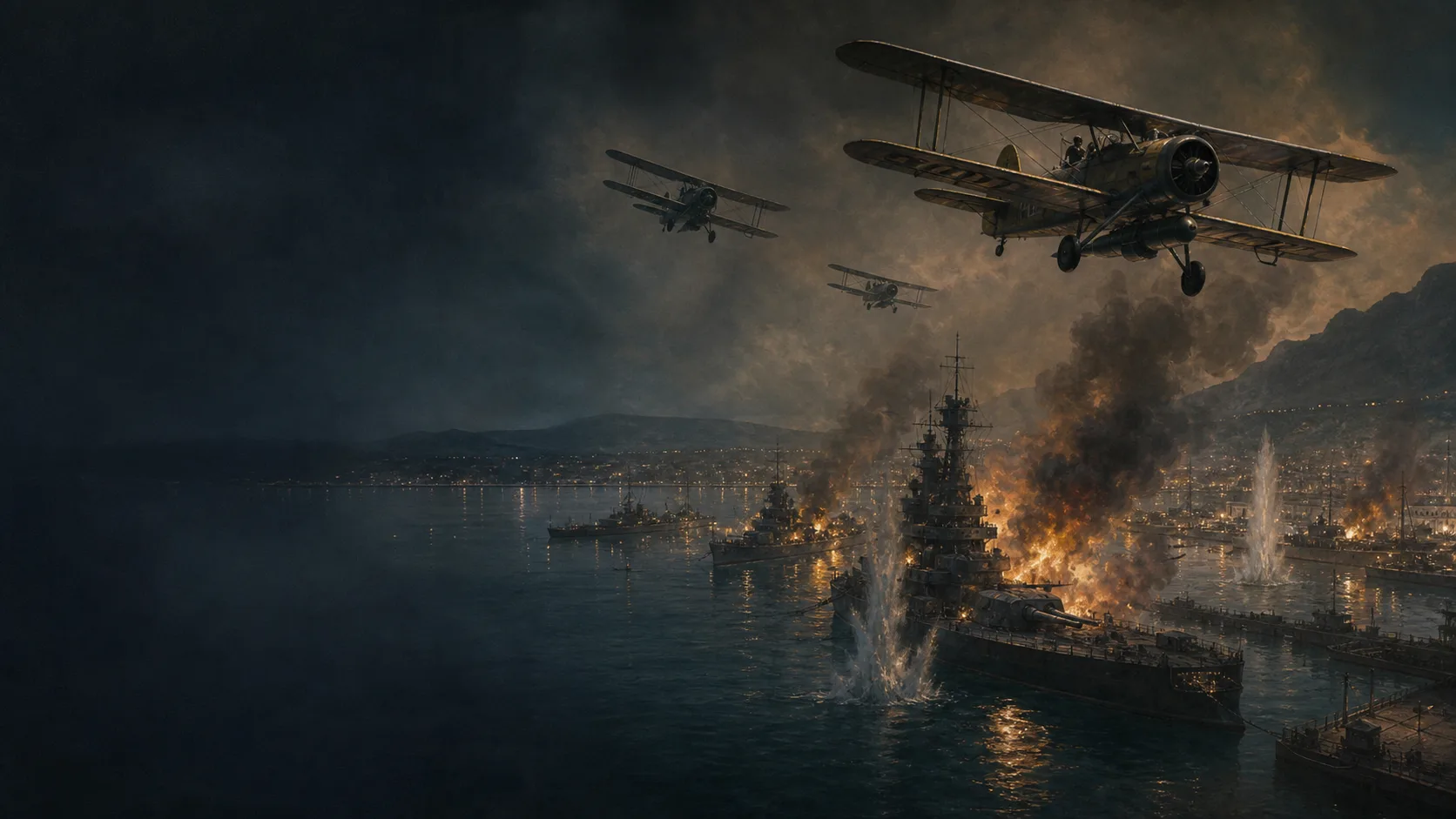
A handful of aircraft turns a protected harbor into a vulnerable target.

Military history

How did a small nocturnal air attack produce a naval effect greater than its number of aircraft?

Taranto was a short battle, almost minimalist on the map. Its significance lies in the relationship among intelligence, crew preparation, harbor depth, and the choice of torpedoes. The attack did not destroy the entire Italian fleet, but removed ships from operational calculations at a critical moment.

A contested Mediterranean

British convoys to Malta and Egypt depend on preventing the Italian fleet from sailing at the right moment.

A protected harbor

Taranto has defenses, nets, and barrage balloons. The British must find a depth and trajectory compatible with their torpedoes.

A calculated risk

Cunningham accepts the risk to an aircraft carrier in order to strike ships whose mere presence ties down convoys and escorts.

Military history

Sources

Contemporary sourceRapport de l’amiral Andrew Cunningham sur l’opération Judgment

Rapport de l’attaque des 11–12 novembre 1940

Plan, air waves, and naval results.

Naval historyDavid Brown, Carrier Operations in World War II

Passage sur Tarente et l’emploi des Swordfish

Carrier-air preparation and operational consequences.

Military museumImperial War Museums, The Fleet Air Arm Strike on Taranto

Photographie du Mar Grande prise le 10 novembre 1940

Configuration of the outer anchorage, ships present, and the attack of 11 November 1940.

View ↗
Port authorityAutorité portuaire de Tarente, géographie du port

Présentation officielle du port de Tarente

Mar Grande, navigable canal, Mar Piccolo, breakwaters, and harbor footprint.

View ↗

Edited by BattlesInMotion.com