1. Home
  2. World Wars
  3. Second World War
  4. Kasserine

Battle

Kasserine

19 — 25 February 1943

Break through the pass, fail at the exits.

Military history

Why did the Kasserine breakthrough run out of force before reaching Tébessa and Le Kef?

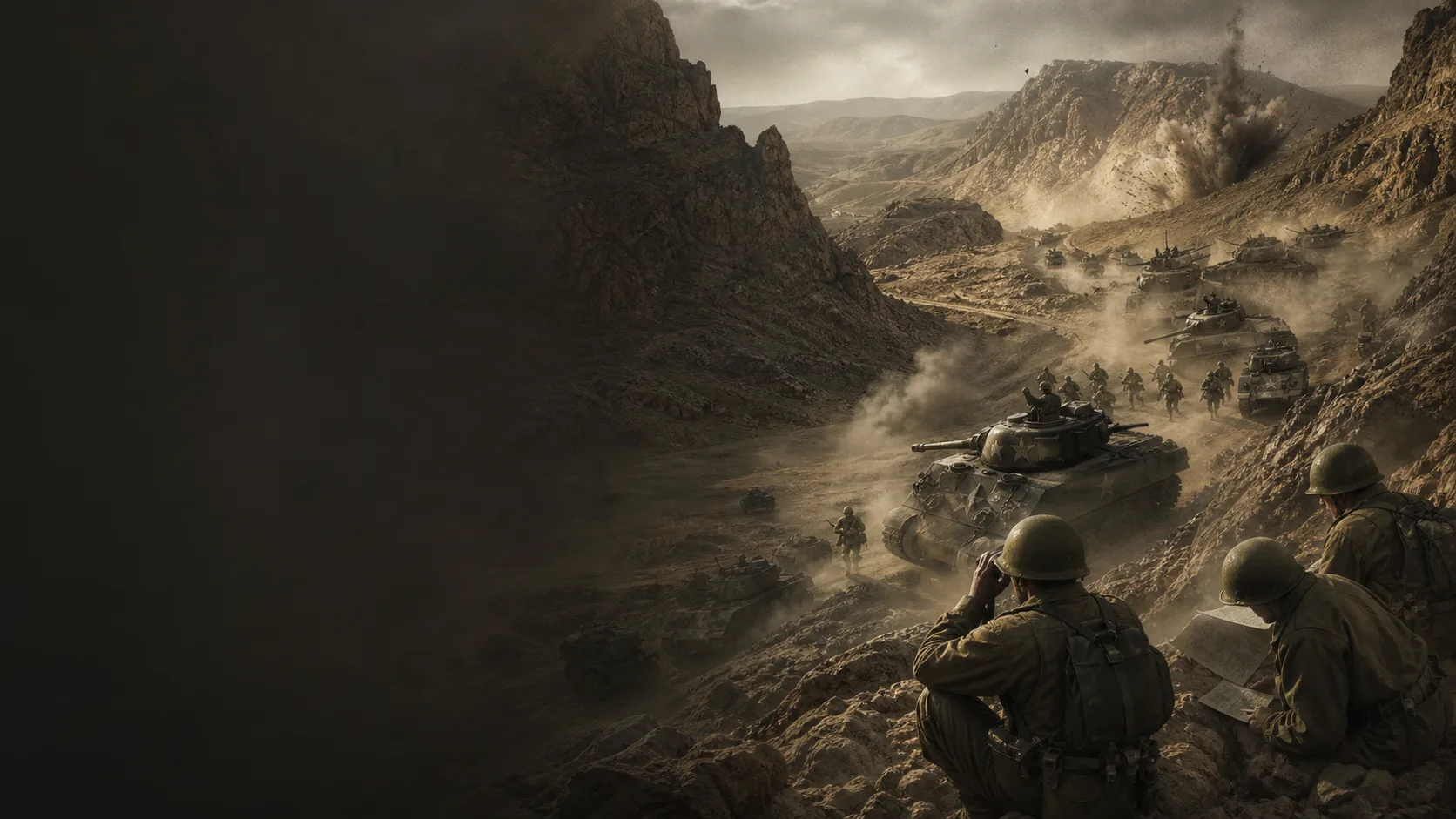
Kasserine was neither an exclusively air battle nor a simple clash of armor. From 19 to 25 February 1943, a German-Italian offensive forced the Western Dorsal: Kasserine fell, while the separate pass at Sbiba held and the approaches toward Tébessa and Thala absorbed the reserves. The initial loss of the pass and the American positions was an Allied tactical defeat; resistance at Djebel el Hamra and Thala, followed by the recapture of the pass, denied the Axis its deeper objective. The lessons about command, antitank weapons, mines and air-ground coordination were real, but no single one explains every phase.

The initiative comes from the east

After Sidi Bou Zid on 14 February and Sbeitla on the 17th, Allied forces retreat and the Axis chooses to exploit the breach toward the Western Dorsal. The Battle of Kasserine is therefore one sequence within a broader offensive, rather than an isolated clash around a single pass.

The pass derives its value from its exits

The road through Kasserine opens into several corridors. Tébessa and Thala become the decision points: the Axis must choose where to concentrate its mobile forces, while the Allies can gain time by sealing one exit with artillery, mines and an armored reserve.

Command under pressure

National sectors, distance, imperfect communications and poor air-ground cooperation slow the Allied response. Yet the improvised defense of the pass and the forces assembled at Djebel el Hamra and Thala show that coordination through fire support and reserves becomes more effective as the threat takes shape.

Military history

Sources

Official history and U.S. Army cartographyGeorge F. Howe, Northwest Africa: Seizing the Initiative in the West

CMH Pub 6-1, chap. XXIII, pp. 438–458 ; carte IX, « Battles at Kasserine Pass and Sbiba Gap, 19–22 February 1943 », entre pp. 441–442 : terrain, défense de Kasserine, Sbiba et perte du col ; chap. XXIV, pp. 459–477 : routes de Tébessa et Thala, repli, reprise et bilan.

Operational mapping of the passes, Tébessa and Thala roads, and Sbiba sector; operational framework, engagements of 19–25 February, limits of exploitation and campaign outcome.

View ↗
Transcript of an official U.S. Army historyGeorge F. Howe, Northwest Africa, chapitre XXIV : The Enemy Is Turned Back

Transcription HTML des sections “The Enemy Is Held on the Tebessa Road” (pp. 459–463), “Thala Narrowly Escapes Capture” (pp. 464–468), “The Enemy Retires Through Kasserine Pass” (pp. 469–474) et “Balance Sheet of the February Battles” (pp. 477–480).

Details on Djebel el Hamra, Nickforce, the separate attacks, withdrawal, losses and the Axis's tactical limits.

View ↗
Primary report by the Supreme Commander to the CCSReport by the Supreme Commander to the Combined Chiefs of Staff on Operations in Northwest Africa

Section “Operations in Northwest Africa”, pp. 35–36 du rapport : attaque du 25 février avec 16th RCT, chars moyens, 804th Tank Destroyer Battalion et 601st Tank Destroyer Battalion, liaison avec la 26th Armoured Brigade, mines, retrait et objectifs manqués.

Primary chronology of recapturing the pass, the Axis withdrawal and assessment of operational objectives.

View ↗
Official British primary documentGeneral Sir Kenneth Anderson, Despatch on Operations in North Africa

Supplement to the London Gazette, 6 novembre 1946, pp. 5452–5457 : coopération armée-air, communications, commandement interallié et défense de la Dorsale occidentale.

Boundaries on cooperation, communications and the limits of Allied command; British context for the roads and reinforcements.

View ↗
Specialist official history of the U.S. Army Corps of EngineersThe Corps of Engineers: The War Against Germany

p. 20, passage “At Kasserine” : noyau de 1 200 hommes du 19th Engineer Combat Regiment, force improvisée avec infanterie, artillerie et tank destroyers, et 1st Battalion, 26th Infantry sur la route de Thala.

A cautious account of the initial defense of the pass and distinction among engineers, infantry, artillery and tank destroyers.

View ↗
Specialist study from the U.S. Army Command and General Staff CollegeMark T. Calhoun, Defeat at Kasserine: American Armor Doctrine, Training, and Battle Command in Northwest Africa, World War II

Thèse MMAS, pp. 26–31 : défense et perte du col, répartition des poussées et Djebel Hamra ; p. 47 : soutien air-sol ; pp. 79–88 : interprétation sur doctrine, formation, équipement et commandement. Les conclusions sont celles de l’auteur, à distinguer d’une position officielle automatique.

Specialist reading of the causes of the American tactical defeat, limits of its weapons and learning after Kasserine.

View ↗
Specialist institutional synthesisMark T. Calhoun, Kasserine Pass: German Offensive, American Victory

Sections sur l’opération de Gafsa et les objectifs, paragraphes 39–46 ; terrain et défense, paragraphes 50–59 ; interprétation et leçons, paragraphes 75–82.

Placing Kasserine, Sbiba and Thala in sequence and distinguishing an American tactical defeat from an Axis operational failure.

View ↗
Official U.S. Army chronologyChronology, 1941–1945

PDF p. 107, entrées des 21–25 février 1943 : containment de Thala et de Tébessa, retrait de Rommel, reprise de Kasserine et concentration de la 9th Division à Tébessa.

Independent chronological check on the end of the sequence and the recapture movements.

View ↗

Edited by BattlesInMotion.com