1. Home
  2. World Wars
  3. First World War
  4. Megiddo

Battle

Megiddo

19 — 25 September 1918

Deception opens the coastal plain, then cavalry turns the breakthrough into collapse.

Military history

How did a concealed concentration on the coast turn a tactical breakthrough into the disappearance of an Ottoman army?

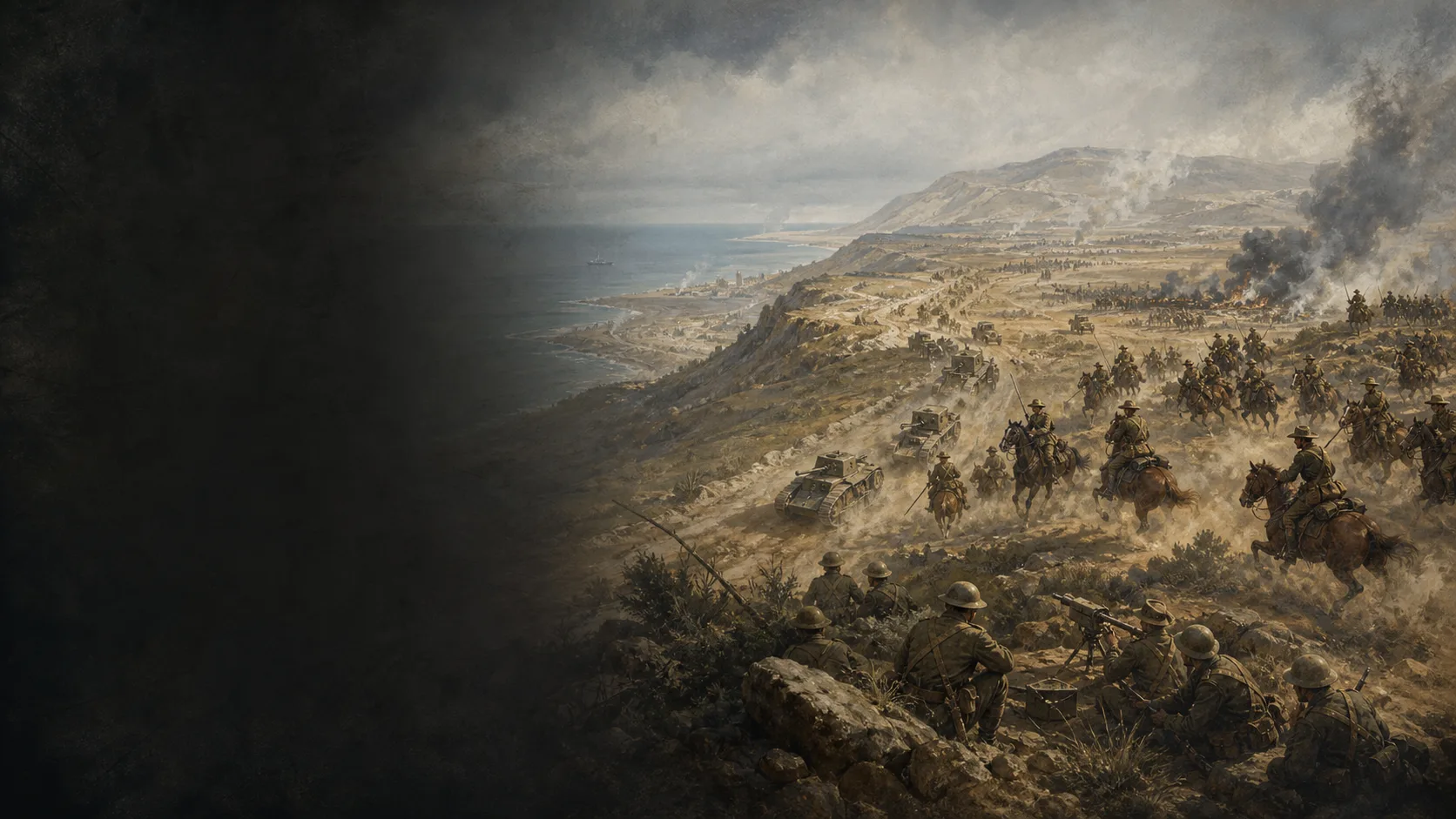
Megiddo was a battle of deception and depth. The Ottomans expected the British main effort in the hills; Allenby concentrated his forces on the coastal plain, where cavalry could reach roads and headquarters.

A fragile Ottoman front

The Ottoman armies lack men, equipment, and reserves. Their deployment rests on the assumption that the main attack will come through the hills.

British secrecy

Allenby minimizes signs of the coastal concentration and maintains activity in the eastern sector.

The plain as an accelerator

Once the line is open, the plain allows mounted formations to cross in a few hours distances that would take infantry far longer.

Explore

Chronological dossier

Battle · 21 February — 15 December 1916VerdunThe German concentration opens the right bank but does not take Verdun; reliefs, artillery and the Sacred Way stabilise both banks, then the October and December offensives recapture Douaumont, Vaux and most of the eastern gains.Battle · 24 October — 12 November 1917CaporettoThree coordinated penetrations through Plezzo, the Isonzo valley and the ridges shatter the IV and XXVII Corps, then the pursuit drives the Italian army back to the Piave.Battle · 8 — 12 August 1918AmiensThe Allies combine tanks, artillery, aviation and infantry to break German defences before they can be rebuilt.Battle · 26 — 30 August 1914TannenbergThe Germans strip the north, strike Samsonov's two wings separately, then close the roads through Neidenburg, Passenheim and Willenberg around his centre.Battle · 19 February 1915 — 9 January 1916Gallipoli CampaignMines halt the naval gamble; separate landings remain contained below the ridges, then deception enables the evacuation of Anzac, Suvla and Helles.Battle · 1 July — 18 November 1916Battle of the SommeThe bombardment produces opposite results in different sectors; gains in the south and at Bazentin run into strongpoints and reserves, then four months of adaptation push the front back without opening it.Battle · 4 June — 20 September 1916Brusilov OffensiveFour armies prepare several sectors and open the Austro-Hungarian front together; when reserves belatedly concentrate towards Kovel, the Stokhid, German reinforcements and lengthening supply lines exhaust the exploitation.Battle · 31 May — 1 June 1916Battle of JutlandHipper draws Beatty towards Scheer, then Beatty leads the pursuit back onto Jellicoe; two unfavourable deployments force Scheer to disengage through battle turns, smoke and torpedoes, before a night escape saves his fleet without loosening the blockade.

Military history

Sources

Contemporary official historyCyril Falls, Military Operations Egypt and Palestine

Chapitres sur l’offensive de septembre 1918

Chronology, orders of battle, and mounted exploitation.

Modern studyEdward J. Erickson, Ottoman Army Effectiveness in World War I

Passages sur la Palestine et la retraite de 1918

State of the Ottoman forces and limitations of command.

View ↗
Institutional overviewAustralian War Memorial London, « Megiddo: Allenby’s Masterstroke »

Dossier consacré à l’offensive de Megiddo de septembre 1918

Deception in the Jordan Valley, the breakthrough at Sharon, mounted exploitation, map reconstruction, and the significance of the victory.

View ↗

Edited by BattlesInMotion.com