1. Home
  2. World Wars
  3. Second World War
  4. Battle of the Bulge

Battle

Battle of the Bulge

16 December 1944 — 25 January 1945

Surprise opens three axes; roads, held junctions and logistics near collapse break the German timetable before the Meuse.

Military history

How did German surprise lose its tempo before the Meuse and then yield the initiative to Allied counteroffensives?

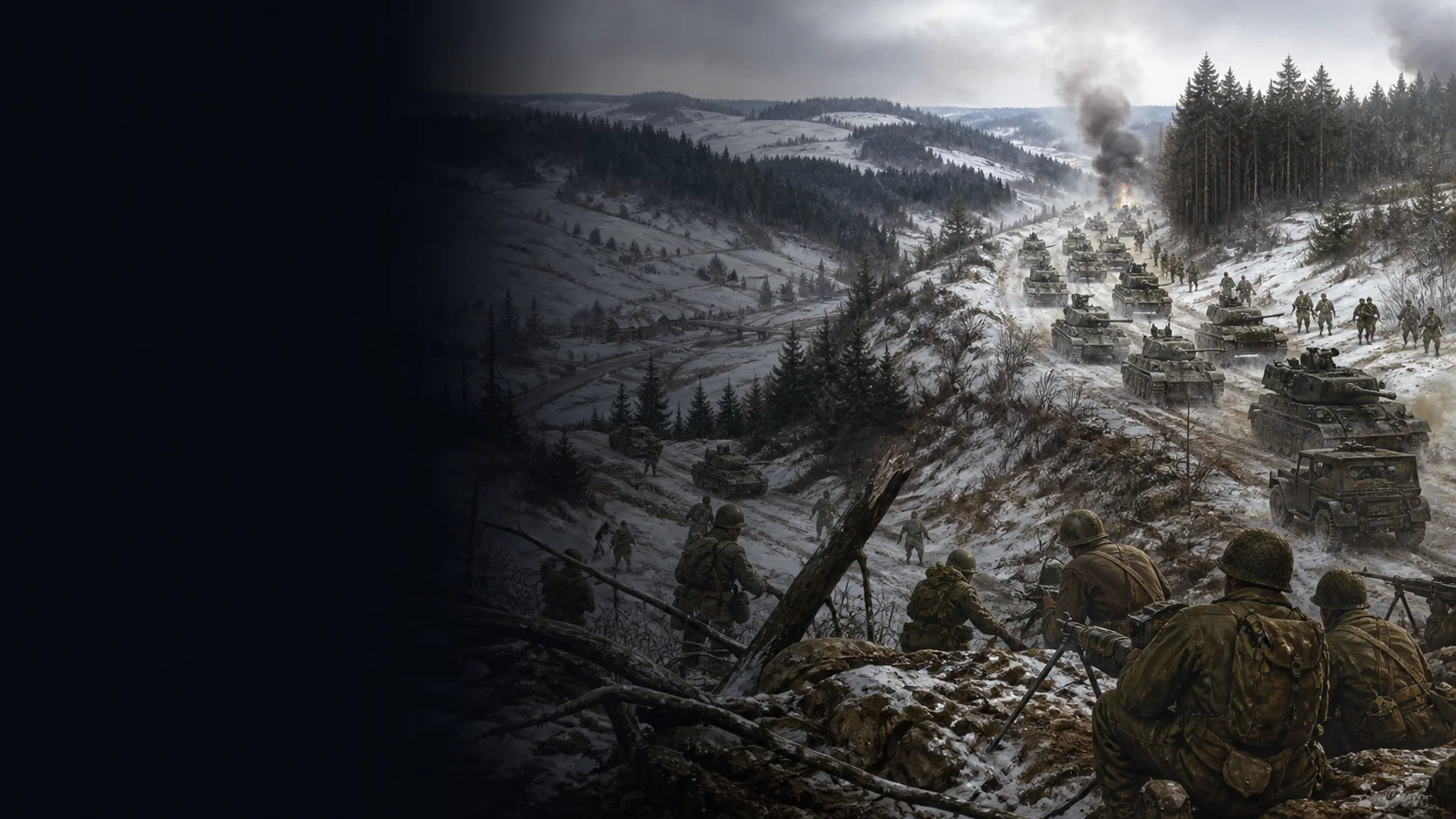
On 16 December 1944, Army Group B struck a stretched American sector between Monschau and Echternach. The plan did not target Bastogne alone: two panzer armies were to cross the Meuse between Liège and Namur and then reach Antwerp, while a third army covered the southern flank. The rupture was real. In the Losheim Gap, American communications came apart and two regiments of the 106th Division were encircled; farther north, the Elsenborn shoulder held; in the centre, Saint-Vith delayed access to the road network; in the south, Bastogne was isolated but columns bypassed it westward. On 25 December, the spearhead of the 2nd Panzer Division approached the Dinant bridges without reaching the Meuse. This result arose from a bundle of constraints—local resistance, narrow axes, traffic jams, breakdowns, fuel distribution, Allied reinforcements and counterattacks—which the return of clear skies amplified without creating. The dossier then follows reduction of the salient through 25 January; it excludes Operation Nordwind, conducted separately in Alsace, from this trace.

A grand solution beyond the available means

The plan first required bridgeheads over the Meuse between Liège and Namur, then Antwerp and the encirclement of Allied forces in the north. Model, Rundstedt and their staffs proposed variants limited to the east of the Meuse; Hitler retained the distant objective without providing the additional means Jodl considered necessary. The offensive therefore depended on an immediate rupture, rapid advance and seizure of intact bridges.

Surprise and warning signs coexist

Secrecy, night marches, radio silence and false German assembly areas concealed the concentration. On the Allied side, seven signs become visible in retrospect in VIII Corps reports between 13 and 15 December, but they were fragmentary and interpreted within a model chiefly expecting a German reaction in the north. Poor weather reduced reconnaissance; it did not eliminate it: 71 missions were still flown from 10 to 15 December, with only one day entirely grounded.

Road junctions

Elsenborn closed the northern shoulder; Saint-Vith held an indispensable crossroads and disorganised German flows; Bastogne blocked several roads in the south, but the 2nd Panzer Division bypassed it to continue towards the Meuse. Peiper, meanwhile, was trapped in the Amblève valleys after bridges were demolished. These points of resistance were neither planned simultaneously nor omniscient: their cumulative effect narrowed the free axes and gave Allied reserves time to arrive.

Baugnez: a crime and a bounded moral effect

On 17 December, at the Baugnez crossroads south-east of Malmedy, men of Kampfgruppe Peiper killed more than 80 American prisoners. Cirillo states that the news spread within hours and stiffened American resistance. This moral effect remains placed in a chain that also includes destroyed bridges, local resistance, the road network and logistics.

Military history

Sources

Retrospective primary source — German participant study, Foreign Military Studies, US ArmyHasso von Manteuffel, The 5th Panzer Army in the Ardennes Offensive, MS B-151 (1946)

PDF p. 4, ‘Preliminary Remarks’ (absence d’archives et limites de mémoire) ; pp. 23–37, ‘The Purpose and Objective of the Offensive Planned’ et missions des armées ; pp. 139–152, matériel, véhicules et carburant ; pp. 180–185, effets de la dissimulation, dépôts, transports et tableau des unités de consommation.

The Fifth Panzer Army commander's perspective on objectives, method of attack, secrecy, transport and fuel distribution, always checked against the official histories.

View ↗
Official German archival synthesisBundesarchiv, Unternehmen ‘Wacht am Rhein’ — Die deutsche Ardennenoffensive im Winter 1944/45

Sections ‘Beginn der Offensive’ et ‘Vom Angriff zur Verteidigung’ ; paragraphes commençant par ‘Am 16. Dezember 1944 starteten Wehrmacht und Waffen-SS’, ‘Ziel des deutschen Großangriffs mit über 200.000 Soldaten’ et ‘Ende Dezember 1944 mussten sie von der Offensive in die Defensive wechseln’. Référence d’archives RH 19-IV.

German objective, official German order of magnitude and general transition from attack to defence; the entry's simplifications on tanks and weather do not carry the causal account alone.

View ↗
Critical university thesisC. Scott Blanchette, Re-examining the Battle of the Bulge: Strategic Intelligence and Coalition Warfare (University of North Texas, 1998)

PDF pp. 31–34 (pages imprimées 23–26), plan de dissimulation et interprétations divergentes ; pp. 49–57 (pages imprimées 41–49), reconnaissance aérienne, météo et images contradictoires ; pp. 73–74 (pages imprimées 65–66), conclusion sur information, diffusion et coalition.

Critical reading of surprise as a combination of German concealment, fragmented signs, collection priorities, interpretations and coalition structures.

View ↗
Official US Army history — direct chapter held by SUB GöttingenHugh M. Cole, The Ardennes: Battle of the Bulge, chap. II — Planning the Counteroffensive

pp. 19–29 : liste des objectifs à l’ouverture de ‘Details of the Plan’ ; pp. 22–28, Meuse, Anvers, trois armées, mauvais temps et débat Big Solution / Small Solution ; section ‘A Double Envelopment?’ à partir de p. 29.

Objectives, army axes, dependence on tempo and disagreement between Hitler, OKW, OB West and Army Group B.

View ↗
Official US Army history — direct chapter held by SUB GöttingenHugh M. Cole, The Ardennes: Battle of the Bulge, chap. IV — The Preparations

pp. 48–55, secret, couverture et mouvements nocturnes ; pp. 57–64, estimations alliées, sept indices des 13–15 décembre et 71 missions aériennes des 10–15 ; pp. 65–74, 500 trains, concentration et ravitaillement allemands.

German preparation, limits of Allied warning, aerial reconnaissance and the offensive's logistical construction.

View ↗
Official US Army history — direct chapter held by SUB GöttingenHugh M. Cole, The Ardennes: Battle of the Bulge, chap. VII — The German Northern Shoulder / Losheim Gap

pp. 137–140, ‘Dispositions of the 106th Infantry Division’ et géographie du Losheim Gap ; section ‘The Attack in the Losheim Gap’ ; fin du chapitre, encerclement et reddition des 422e et 423e régiments, estimation d’au moins 7 000 prisonniers.

Losheim Gap terrain, stretched American disposition, 16 December breakthrough and lower bound for captures in the Schnee Eifel.

View ↗
Official US Army history — direct chapter held by SUB GöttingenHugh M. Cole, The Ardennes: Battle of the Bulge, chap. XI — The 1st SS Panzer Division’s Dash Westward

pp. 264–270 : route de Peiper, Stavelot, dépôts de carburant, ponts de Trois-Ponts et repli vers La Gleize ; p. 266, arrêt nocturne à 42 miles de la Meuse ; pp. 267–268, destructions de ponts et sortie de vallée fermée.

Northern axis, valley constraints, destroyed bridges, fuel captured or missed and isolation of Kampfgruppe Peiper.

View ↗
Official US Army history — direct chapter held by SUB GöttingenHugh M. Cole, The Ardennes: Battle of the Bulge, chap. XVII — St. Vith Is Lost

pp. 393–401, Saint-Vith comme ‘breakwater’, communications, routes bloquées et périmètre composite ; pp. 402–415, attaque du 21 décembre, prise de la ville dans la nuit du 21 au 22 et retrait achevé du secteur le 23.

Effect of the Saint-Vith crossroads, composite command, German congestion and precise chronology of its loss and subsequent withdrawal.

View ↗
Official US Army history — direct chapter held by SUB GöttingenHugh M. Cole, The Ardennes: Battle of the Bulge, chap. XIX — The Battle of Bastogne

pp. 448–456, contournement de Bastogne par la 2e Panzer et ordre de poursuivre vers la Meuse ; pp. 459–464, encerclement construit jusqu’au soir du 21 ; pp. 479–481, contact de la 4e blindée à 16 h 45 le 26 et corridor maintenu.

Distinction between bypass and investment, chronology of encirclement, defence of the garrison and bounded significance of lifting the siege.

View ↗
Official US Army history — direct chapter held by SUB GöttingenHugh M. Cole, The Ardennes: Battle of the Bulge, chap. XXII — The Battle Before the Meuse

pp. 563–566, pénurie de carburant signalée le 24 et objectifs concurrents ; section ‘The Celles Pocket’, pp. 566–571 ; p. 567, reconnaissance près de Foy-Notre-Dame à quatre ou cinq miles des ponts de Dinant ; pp. 568–570, action américaine et britannique autour de Celles.

Maximum advance, Meuse not reached, fragmentation of the 2nd Panzer Division and armour–artillery–aircraft combination at Celles.

View ↗
Official US Army history — direct analytical chapter held by SUB GöttingenHugh M. Cole, The Ardennes: Battle of the Bulge, chap. XXV — Epilogue

pp. 649–650, météo et effectifs d’ouverture ; pp. 660–663, effort aérien, 1 138 sorties tactiques du 24 décembre et limites des revendications ; pp. 667–669, carburant, transport et congestion ; pp. 669–675, point culminant et pertes du 16 décembre au 2 janvier.

Comparable opening strengths, varying effects of weather and aircraft, logistics, culminating point and checking December casualties.

View ↗
Official US Army Center of Military History synthesisRoger Cirillo, Ardennes-Alsace, 16 December 1944–25 January 1945

pp. 5–9, terrain, nœuds routiers et écran américain ; PDF pp. 24–25, page imprimée 20, paragraphes commençant par « Then shortly after noon » et « Word of the Malmedy Massacre spread » : plus de 80 prisonniers tués au sud-est de Malmedy et diffusion de la nouvelle ; pp. 36–50, levée du siège, Nordwind distincte et contre-offensives du 3 au 25 janvier ; pp. 51–53, 32 divisions US, pertes ardennaises de décembre/janvier, pertes de l’Alsace et fourchettes allemandes.

Complete scope through 25 January, Baugnez massacre and spread of the news, Ardennes–Alsace distinction, counteroffensives, Houffalize junction, recapture of Saint-Vith and compared casualty assessments.

View ↗
Contemporary official report — SHAEF / Combined Chiefs of StaffDwight D. Eisenhower, Report by the Supreme Commander to the Combined Chiefs of Staff on the Operations in Europe of the Allied Expeditionary Force, 6 June 1944 to 8 May 1945

PDF pp. 78–80 (section Ardennes) : l’offensive est contenue au 26 décembre, l’initiative passe ensuite aux Alliés, la jonction First–Third Armies à Houffalize intervient le 16 janvier, Saint-Vith est reprise le 23 et la ligne de fin janvier revient vers le front initial ; p. 79, durée du retard et estimations de pertes allemandes, conservées ici comme évaluations de commandement contemporaines et non comme bilan établi.

Contemporary bound for the operational chronology and checking consequences announced by Allied command; casualty and equipment figures in the report are explicitly treated as situation estimates.

View ↗

Edited by BattlesInMotion.com