1. Home
  2. World Wars
  3. Second World War
  4. Operation Bagration

Battle

Operation Bagration

22 June — 19 August 1944

Four Soviet fronts distort the German reading, break through in several sectors, close Vitebsk and Bobruisk, then exploit before Army Group Centre can re-form a front.

Military history

How did maskirovka, simultaneous breakthroughs, and mobile exploitation destroy Army Group Centre?

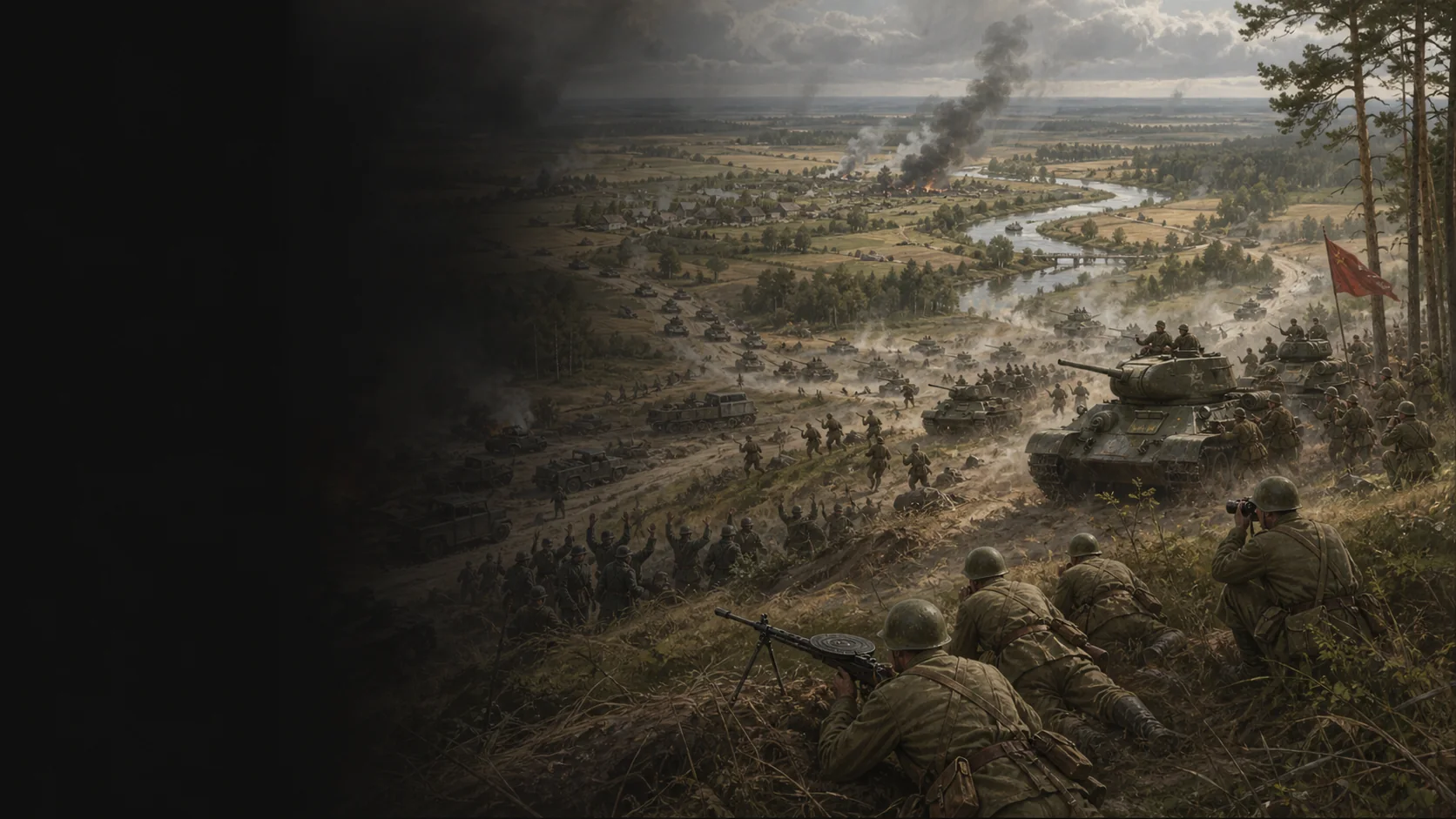
In spring 1944, Army Group Centre still held a vast salient in Belarus. Its staff detected several Soviet preparations, but German decisions over priority and reserves remained poor. Stavka prepared four fronts, separate breakthroughs, and a two-stage plan: first encircle the groupings at Vitebsk and Bobruisk, then converge on Minsk. From June 22 to early July, firepower, infantry, and aircraft opened the passages; mobile groups reached the roads and bridges before the German armies could withdraw. After Minsk, the pursuit widened towards Vilnius, Białystok, Brest, Lublin, and the Vistula, but distances, destroyed railways, and German reserves created new sectoral slowdowns. The map therefore distinguishes the Belarusian core from its follow-on operations and does not draw a continuous line to Warsaw.

Conceal the mass while leaving clues

Stavka assembles four fronts, moves them at night, restricts radio transmissions, and multiplies false indicators. Army Group Centre sees preparations increasing and identifies several threatened sectors; the error chiefly concerns their cumulative scale, the theatre's priority, and allocation of reserves. Surprise is therefore relative: an advantage in decision-making. Total disappearance of the information goes beyond the dossier.

A long line with little depth

Thirty-eight German front-line divisions cover about 780 kilometres according to the U.S. official history. Requests for rear positions and a shorter line are refused or delayed; Vitebsk, Orsha, Mogilev, and Bobruisk are ordered to hold. This posture gives the Soviets fixed objectives, but no pocket exists until mobile formations close the exits.

Firepower, breach, mobility

Artillery and infantry open the defences; Soviet aircraft hinder German observation and movement; armoured and mechanised corps then pass towards the communications. Partisans provide intelligence and sabotage the railway, but Connor bounds their immediate effect: above all, they hinder the later arrival of reinforcements. Collapse comes from the combination, not one factor.

One victory, several scopes

The mapped dossier ends on August 19. The Soviet statistical table covers the Belarusian operation from June 23 to August 29; Vilnius, Białystok, Lublin–Brest, and the approaches to Warsaw overlap with follow-on operations. The statistical initial strength of 2.33 million is therefore not equivalent to the 1.2 million combatants Ziemke places in the attack zone at the outset.

Military history

Sources

U.S. official history based on the German and Soviet archives then availableEarl F. Ziemke, Stalingrad to Berlin: The German Defeat in the East, U.S. Army Center of Military History

Chapitre XV, « Operation Bagration », pp. imprimées 313–328 : pp. 313–318 pour forces, plan et renseignement ; pp. 319–325 pour les quatre ruptures, Bobrouïsk, Bérézina et Minsk ; pp. 325–328 et la section de poursuite pour distances, rails détruits et rétablissement progressif du front.

Orders of magnitude at the outset, cross-checked chronology, Busch–Model decisions, fate of the German armies, and logistical constraints on the pursuit.

View ↗
Critical institutional military monographWilliam M. Connor, Analysis of Deep Attack Operations: Operation Bagration, Belorussia, 22 June–29 August 1944, Combat Studies Institute

PDF CSI/Army University Press : pages PDF 19–31 pour forces, logistique, transmissions, maskirovka, partisans et aviation ; pages PDF 37–61 pour le dispositif, les ouvertures successives, Vitebsk, Mogilev, Bobrouïsk, Minsk et la poursuite ; annexes C–D, pages PDF 77–81, pour la corrélation des forces et la chronologie de planification du 5 avril au 18 juillet.

Multi-front mechanism, distinction between breakthrough and exploitation, bounded effect of the partisans, planning sequence, and limits of teleology.

View ↗
German participant report published with critical apparatusHermann Gackenholz, « Zum Zusammenbruch der Heeresgruppe Mitte im Sommer 1944 », Vierteljahrshefte für Zeitgeschichte, 1955

PDF du fascicule 3/1955, pp. imprimées 318–333 : pp. 318–319 pour la genèse à partir du journal de marche ; pp. 320–325 pour indices, 38 divisions, demandes de repli, ordres de tenir, aviation et Vitebsk ; pp. 328–333 pour Model et la reconstruction occidentale.

Perception and constraints at German headquarters, with caution regarding participant status and possible retrospective defence of local command.

View ↗
Modern academic historiographical essayDavid M. Glantz, The Soviet-German War 1941–1945: Myths and Realities: A Survey Essay

Clemson University, 2001, pp. imprimées 73–79 : groupe Centre, forteresses et ordres de tenue ; séquence Bagration–Minsk ; expansion vers Vilnius, Białystok et Lublin–Brest ; approches de Varsovie et contre-coup allemand de la fin juillet.

Separating the Belarusian core from follow-on offensives, controlling the significance towards Warsaw, and correcting the account of instantaneous destruction.

View ↗
Primary sources, Russian institutional archivesSociété historique russe, Documents on liberation of occupied Belarus, fonds du Central Archive of the Russian Ministry of Defence

Page « Documents on liberation of occupied Belarus » : entrée de l’opération 23 juin–29 août et étape 1, 23 juin–4 juillet ; rapports du 3e front de Biélorussie no 244/OP du 23 juin (f.241, op.2593, d.232, l.97), no 260/OP du 27 juin (l.132–133), no 262/OP du 27 juin (l.140), no 278/OP du 1er juillet (d.233, l.1), no 289/OP du 3 juillet (l.16) ; cartes de situation de Vitebsk du 26 juin (f.241, op.2593, d.1/4).

Dates and nodes at Vitebsk, Orsha, Berezina, Borisov, and Minsk from contemporary reports and maps; primary check on the initial phase's chronology.

View ↗
Modern critical synthesis from the Bundeswehr Military History CentreChris Helmecke, « Zusammenbruch im Osten. Die sowjetische Operation “Bagration” und die Zerschlagung der Heeresgruppe Mitte im Sommer 1944 », Militärgeschichte, 2/2024

PDF direct, pp. imprimées 30–33 (pages PDF 30–33) : pp. 30–31 pour l’appréciation allemande, les quatre fronts, les ordres de tenir et la carte fondée sur les Lagekarten de l’OKH ; p. 33, amorces « Hitler ließ Busch am 28. Juni ablösen » et « Im Juli 1944 ließ der Angriffsschwung », pour la relève par Model, Minsk, les difficultés logistiques et les contre-coups qui consolident sectoriellement le front.

Modern German counterpoint on errors of assessment, command rigidity, the Busch–Model transition, and culmination, without adopting its casualty totals as a symmetrical balance.

View ↗
Official post-Soviet statistical collectionComité statistique de la CEI, 80 ans de la Grande Victoire 1941–1945, recueil statistique

Édition 2025, p. 71, ligne « Белорусская стратегическая наступательная операция “БАГРАТИОН” » : dates 23 juin–29 août 1944, effectif initial 2 331 700, pertes irrécupérables 178 507, sanitaires 587 308, total 765 815 et moyenne quotidienne 11 262.

Soviet strength and losses with explicit dates, categories, and scope; the line is not used to assign the strength to four fronts or measure depth of advance.

View ↗
Polish institutional synthesis based on archivesTeodor Gąsiorowski, « Burza nadeszła ze wschodu », Instytut Pamięci Narodowej

Sections « Ostra Brama — przyspieszony atak » et « Burza mimo wszystko » : début de l’attaque de Vilnius le 7 juillet avec environ 30 % des forces prévues, arrivée soviétique le soir, prise le 13 juillet, désarmements et arrestations ; district de Białystok, environ 2 500 mobilisés et attaques contre les Allemands en retraite.

The Home Army's own objectives and action at Vilnius, the political consequence of the Soviet arrival, and distinction between military liberation and political takeover.

View ↗
German institutional historical cartographyZentrum für Militärgeschichte und Sozialwissenschaften der Bundeswehr, « Operation Bagration 1944 »

Page et carte « Operation Bagration 1944 », chronologie 22 juin–29 août : axes des quatre fronts, nœuds biélorusses et limites successives de l’opération ; utilisé comme contrôle de topologie, avec une fonction distincte de celle d’une preuve d’une position quotidienne.

Modern German check on the operational space, directions of pursuit, and difference between the initial front and late-August limits.

View ↗
Official university military cartographic atlasWest Point Department of History, carte 30 — Operation Bagration, 22 June–19 August 1944

Fichier image officiel WWIIEurope30.jpg, fenêtre 22 June–19 August 1944 : positions relatives Vitebsk–Orcha–Mogilev–Bobrouïsk, Minsk, Brest et Warsaw, axes de fronts et lignes successives.

Temporal scope of the educational map and topology of cities, rivers, and major axes; positions in the JSON remain schematic.

View ↗

Edited by BattlesInMotion.com