1. Home
  2. World Wars
  3. Second World War
  4. Battle of Berlin

Battle

Battle of Berlin

16 April — 2 May 1945

Break through, encircle, compartmentalise

Military history

How do the crossings of the Oder and Neisse encircle Berlin while isolating the 9th Army at Halbe?

The Battle of Berlin does not begin with an urban attack. It starts from Soviet bridgeheads already established on the Oder while Konev crosses the Neisse to the south; it then passes through Seelow, the Halbe pocket and the closing of the ring before becoming a struggle along distinct axes within Berlin.

Two crossings, two situations

Zhukov’s 1st Belorussian Front attacks on 16 April from Soviet bridgeheads already established west of the Oder around Küstrin. To the south, Konev’s 1st Ukrainian Front crosses the Neisse: the map distinguishes these two starting points instead of merging them into a single “creation of bridgeheads.”

The scope of the forces

Weber and co-authors give about 900,000 Soviet troops and 4,600 tanks for the three fronts in the initial attack along a line roughly 300 kilometres long. They also give 126,602 men, 10,400 guns and 754 tanks for the German deployment opposing that whole force: this figure describes neither the Seelow sector alone nor Berlin’s final garrison.

The 9th Army and the garrison: two separate forces

After the Oder and Seelow defences are broken, Busse’s 9th Army is driven back and then trapped to the southeast in the Halbe pocket. Berlin’s garrison, reinforced in particular by LVI Panzer Corps, forms a separate branch; it does not automatically absorb the 9th Army.

From campaign to city

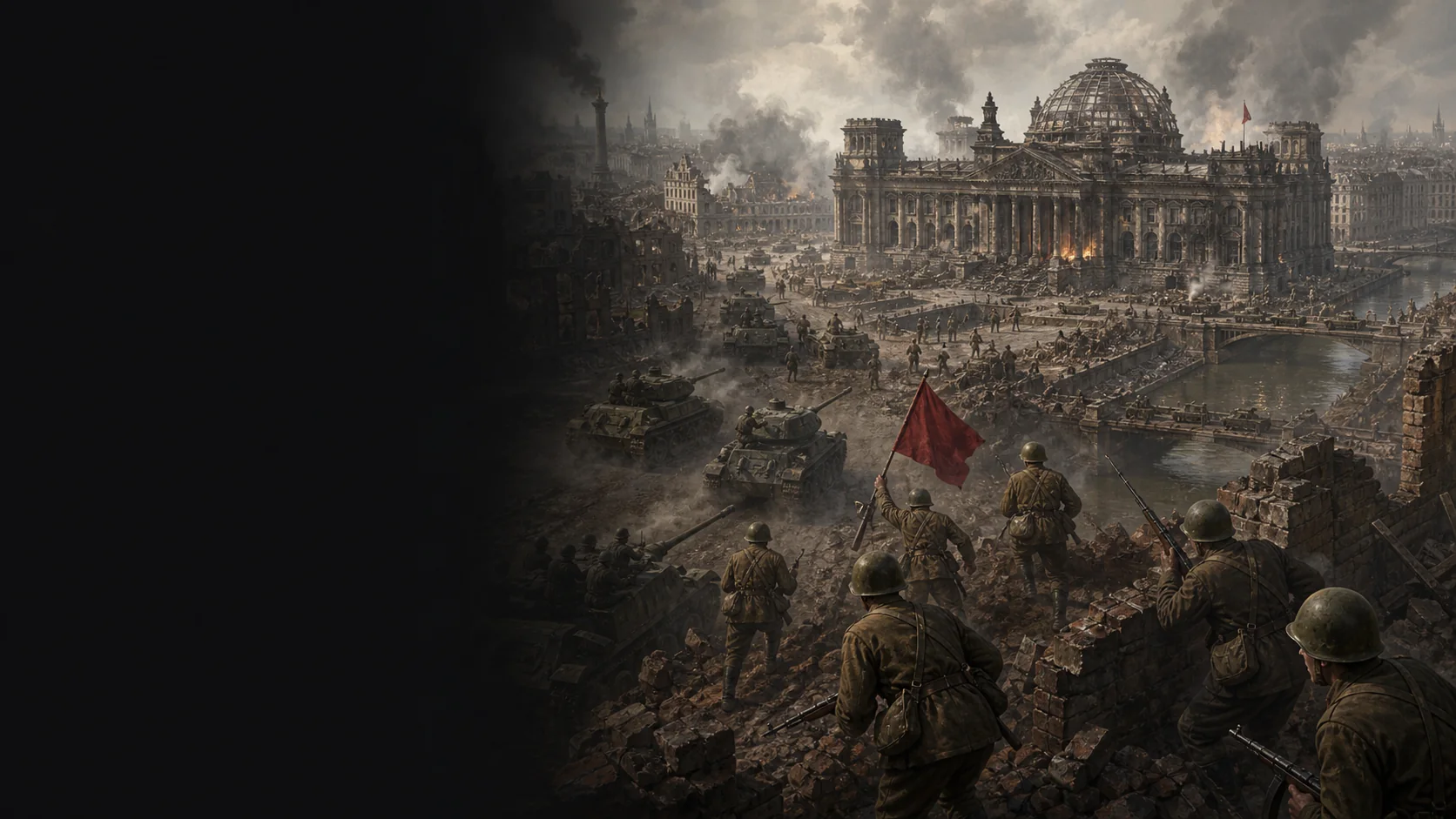
The first spearheads reach the suburbs on 21 April. By the 25th, Berlin is encircled; the Ringbahn, Spree, bridges and streets then turn operational superiority into sector-by-sector progress. The Reichstag is a political and tactical objective on the 3rd Shock Army’s axis, not the indiscriminate destination of every Soviet armoured formation.

Military history

Sources

Primary source and institutional cartographyLagekarte zur Schlacht um Berlin — Bundesarchiv

Sections « Historischer Hintergrund », « Vorbereitungen und Schlacht um die Seelower Höhen » et « Angriff auf Berlin » ; section « Das Dokument » sur la carte RH 24-56/145K, le LVI Panzerkorps, la nomination de Weidling au 24 avril et les trois anneaux de défense.

Chronology from 16 April to 2 May, arrival in the suburbs, encirclement on 25 April, defence of the city, LVI Panzer Corps and Weidling’s surrender.

View ↗
Modern scholarly articleThe Battle of the Seelow Heights, April 1945: Conflict Archaeology in the Forests of Eastern Brandenburg

Introduction, pp. 1–2 : trois fronts, environ 300 km et ordres de grandeur ; « Background to the Study Area » et « Topography and Geology », pp. 5–6 ; passage sur les têtes de pont de l’Oder, PDF p. 8.

Scope of force figures, already established bridgeheads, Oderbruch, Seelow, Küstrin–Berlin axes and limits of the operational reconstruction.

View ↗
Modern specialised historical synthesisBattle for Berlin: April–May 1945 — History of War

Sections « The Battle for the Oder », « Berlin under Siege » et « The Reichstag in Sight » ; Appendix 1, « Soviet Order of Battle for the Battle for Berlin », pour les axes des 3e et 5e armées de choc, de la 8e armée de la Garde et de la 3e armée blindée de la Garde.

Konev’s crossing of the Neisse, breakthrough at Seelow, Halbe pocket, encirclement, urban axes and approach to the Reichstag.

View ↗
Modern institutional publicationThe City Becomes a Symbol: The U.S. Army in the Occupation of Berlin, 1945–1949 — CMH Pub 45-4

Chapter 3, « The Road to Berlin », pp. 29–31 (PDF pp. 50–52) : lancement de Operation Berlin le 16 avril, arrivée des premiers fers de lance dans les faubourgs le 21 avril, Ringbahn, ponts et capitulation de la garnison le 2 mai.

Institutional check of the urban chronology, scope of the operation and constraints imposed by the Spree, bridges and Ringbahn.

View ↗
Local institutional source and urban cartographyMoltkebrücke — Landesdenkmalamt Berlin

Notice « Moltkebrücke », paragraphe historique sur les combats des derniers jours de la guerre et l’attaque soviétique vers le Reichstag depuis Moabit.

Urban landmark and function of the bridge on the 3rd Shock Army’s axis towards the Reichstag.

View ↗

Edited by BattlesInMotion.com